
Haploesthes greggii
Haploesthes greggii
Description
How to tell it apart
Haploesthes greggii, commonly known as Gregg's broomweed, is a perennial herb belonging to the Asteraceae family. It is characterized by its woody base and narrow, thread-like leaves that help it survive in arid environments.
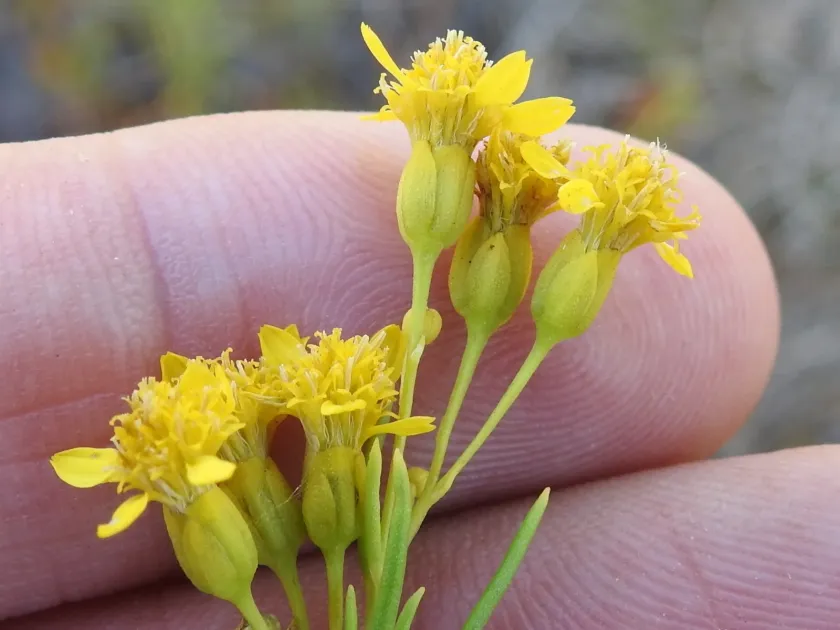
The plant grows as a small, upright shrub and produces small yellow flower heads arranged in loose clusters. These structures are typical for members of the daisy family, aiding in identification during the flowering phase.
It possesses a deep, robust root system that allows it to access water deep within the soil profile, making it a highly resilient and drought-tolerant species in its native range.
Seed dispersal is facilitated by wind-borne achenes, which have small plumes attached to them, allowing the weed to colonize new territories quite rapidly.
The biological cycle of Haploesthes greggii includes a period of vegetative regrowth from the root crown, ensuring the plant's survival after mechanical stress or light grazing.
Where it grows
Haploesthes greggii is primarily found in the southwestern regions of North America, including northern Mexico and states like Texas in the United States, where it thrives in desert grasslands.
It is commonly observed on disturbed sites, such as abandoned agricultural fields, roadsides, and areas with sandy or saline soil conditions where other vegetation struggles to establish.
In an agricultural context, it infests pastures, rangelands, and occasionally crops like sorghum, especially in regions with low precipitation and intensive livestock grazing practices.
The weed shows a high tolerance to alkaline and salty soils, enabling it to dominate areas where soil salinity has increased due to improper irrigation management.
Fallow lands and neglected fence rows act as primary reservoirs for this weed, from which it can spread into active cultivated areas over time.
Harm it causes
The primary economic impact of Haploesthes greggii is the competition for scarce soil moisture, which directly reduces the yield potential of cultivated crops in arid agricultural zones.
In grazing lands, it acts as a competitor to palatable forage species, leading to a decrease in livestock carrying capacity because the weed itself is generally unpalatable.
Infestations increase the complexity of harvest operations, often resulting in higher cleaning and drying costs for grain due to the presence of weed debris.
Its ability to form dense clusters allows the plant to shade out native or desirable species, thereby reducing the biodiversity and productivity of the infested area.
Long-term colonization by this weed can deplete soil nutrients and contribute to soil erosion, as it often displaces more beneficial plant cover in fragile ecosystems.
How to control
Mechanical control, such as deep plowing or disking, is effective in disrupting the root system, although it requires persistence as the plant can regrow from deep roots.
Cultural management through appropriate crop rotation and the use of competitive cover crops can suppress the growth of Haploesthes greggii by limiting its access to sunlight.
Chemical control is often necessary for large infestations, using selective or systemic herbicides applied during the plant's peak growth stage before seed maturation.
Integrated weed management programs, combining herbicide applications with mowing or controlled grazing, yield the best results for long-term population reduction.
- Systemic herbicide application (e.g., glyphosate, 2,4-D combinations).
- Mowing before seed head formation to prevent further spread.
- Maintenance of healthy forage cover to outcompete weed seedlings.
Taxonomy
- Latin name
- Haploesthes greggii
- Family
- Сложноцветные (астровые)
- EPPO code
- HSHGR