
Gutierrezia texana
Gutierrezia texana
Description
How to tell it apart
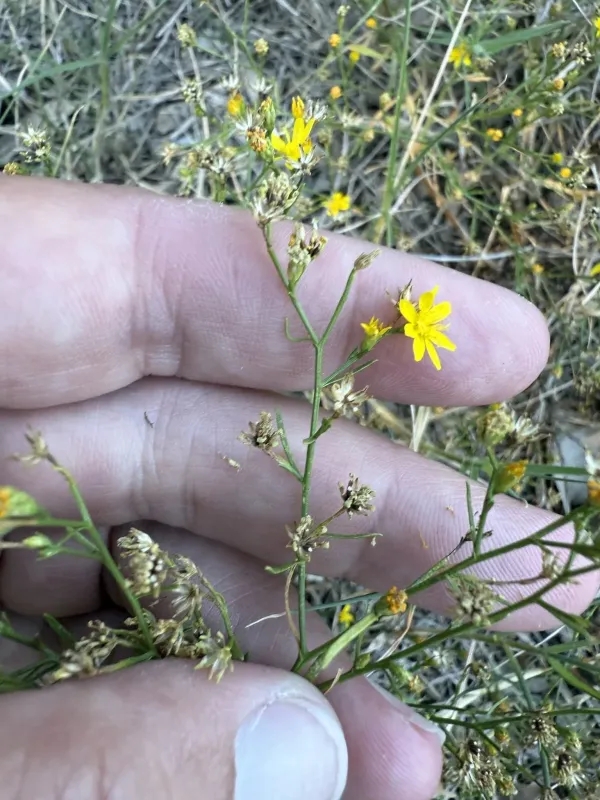
Gutierrezia texana, commonly known as Texas snakeweed, is a perennial subshrub belonging to the Asteraceae family. It typically grows as a densely branched, rounded shrub, reaching heights of 20 to 80 centimeters.
The leaves of this plant are linear and narrow, often coated with a sticky, resinous substance. This resin layer is a distinct feature, providing the plant with protection against harsh environmental conditions and a shiny appearance.
During the summer and autumn months, the plant produces numerous small, yellow flower heads arranged in terminal corymbs. These clusters create a vibrant, yellow display across infested rangelands.
The plant features a deep taproot, which allows it to thrive in arid climates and reach water sources inaccessible to many other plant species. Its root structure is highly resilient, making manual removal challenging.
The vegetative parts of the plant emit a pungent, somewhat unpleasant odor, which is attributed to its high concentration of essential oils and resins, serving as a deterrent to most grazing animals.
Where it grows
Native to the southwestern United States and parts of Mexico, Gutierrezia texana thrives in open, sunny environments. It is frequently found on dry, rocky, or gravelly soils where vegetation is sparse.
This weed is a prolific colonizer of disturbed areas, including overgrazed pastures, roadside embankments, and abandoned agricultural fields. It quickly exploits gaps in the soil cover to establish new populations.
In regions with low rainfall, it becomes a dominant species, effectively utilizing limited moisture better than most native forage grasses. Its ability to survive on poor-quality soil gives it a competitive edge in degraded ecosystems.
The spread of Texas snakeweed is strongly associated with land mismanagement, particularly excessive grazing pressure that removes desirable grass cover and leaves soil exposed to infestation.
It prefers regions with high heat and sunlight, where its drought-tolerant characteristics ensure long-term survival even during severe dry spells that may devastate other pasture plants.
Harm it causes
The primary concern regarding Gutierrezia texana is its significant toxicity to livestock. Ingestion of the plant by cattle, sheep, or goats can cause severe poisoning, frequently leading to abortions in pregnant animals.
It acts as a major competitor for water and soil nutrients, reducing the biomass of beneficial forage species. This leads to a decline in the carrying capacity of pastures and lower economic output for farmers.
Because the plant is resinous and generally unpalatable, livestock avoid it, leaving it to flourish while nutritious grasses are eaten and suppressed. This shift in vegetation composition degrades the quality of the range.
Chronic ingestion of even small amounts can impact the overall health and immune function of livestock, potentially leading to lower weight gains and higher veterinary costs for producers.
Managing land infested with this weed incurs substantial costs, whether through chemical application, mechanical removal, or the need to supplement feed, as the forage value of the land drops sharply.
How to control
Effective control starts with good range management. Maintaining a robust stand of competitive perennial grasses is the best natural defense against the invasion of Texas snakeweed.
Mechanical control, such as mowing, can be effective if done consistently before the plants set seed. However, it is labor-intensive and often serves as a stop-gap measure rather than a total eradication strategy.
Chemical control via herbicides is the most reliable method for large-scale infestations. Systemic herbicides are preferred as they ensure the active ingredient travels deep into the root system to prevent regrowth.
- Application of selective herbicides (like picloram or 2,4-D).
- Spot-spraying isolated patches to prevent the expansion of infestations.
- Careful monitoring of grazing intensity to allow native grasses to recover.
- Prescribed burning, though its effectiveness varies depending on timing and conditions.
A long-term management strategy integrating chemical intervention with planned grazing rotations is essential to keep the population of Gutierrezia texana below economic damage thresholds.
Taxonomy
- Latin name
- Gutierrezia texana
- Family
- Сложноцветные (астровые)
- EPPO code
- GUETE