
Curly-cup gumweed
Grindelia squarrosa
Description
How to tell it apart
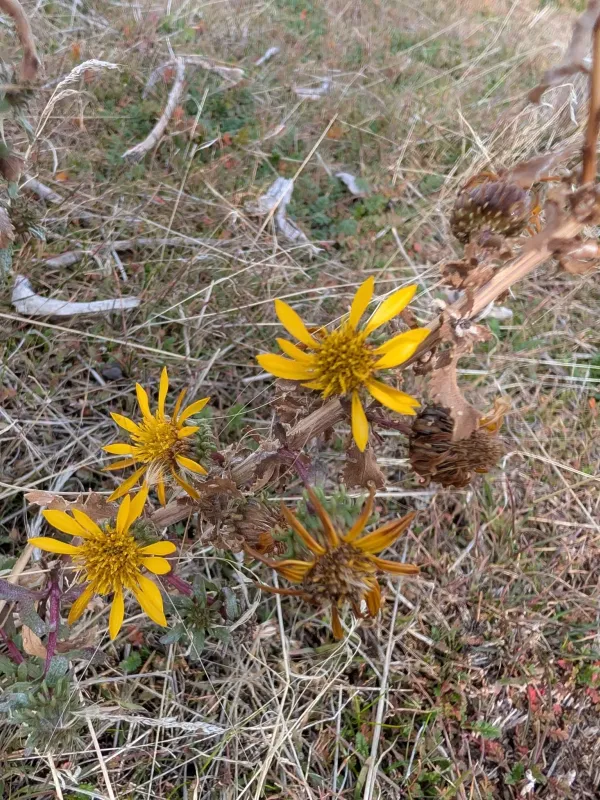
Curly-cup gumweed (Grindelia squarrosa) is a perennial or biennial herb belonging to the Asteraceae family. It is easily recognized by its distinctive resinous, sticky appearance.
The plant features a stiff, branched stem typically reaching heights of 30 to 80 centimeters. Its leaves are alternate, oblong, and have serrated margins, covered in glands that secrete a sticky resin.
The inflorescences are yellow flower heads, surrounded by a series of downward-curving, sticky bracts. These curled bracts are the defining characteristic that gives the plant its name.
Blooming from mid-summer until late autumn, the plant produces numerous small, bright yellow composite flowers that transition into seeds.
It possesses a strong, deep taproot, which allows the plant to access deep soil moisture and nutrients, ensuring its survival even during prolonged dry spells.
Where it grows
Native to the prairies of North America, Curly-cup gumweed has become a widespread invasive weed in many regions across the globe due to its adaptability to various environments.
It thrives in open, disturbed areas such as roadsides, railway embankments, abandoned fields, and overgrazed pastures where competition is low.
In agricultural settings, it frequently invades row crops and cereals, particularly in fields where soil management practices are insufficient or the crop canopy is thin.
The plant is highly tolerant of saline and alkaline soils, which allows it to thrive in arid and semi-arid landscapes where other crops often struggle to establish.
Its lightweight seeds are easily transported by wind, water, and agricultural equipment, facilitating rapid colonization of new farmland.
Harm it causes
The primary harm caused by Curly-cup gumweed is its intense competition with crops for water and mineral nutrients, especially in semi-arid farming regions.
Its sticky resinous foliage and robust growth habit can shade out young crops, reducing photosynthetic efficiency and overall biomass production.
When present in hay fields, the resinous nature of the plant can lower forage quality, as livestock often find it unpalatable or develop a preference for avoiding contaminated hay.
The plant serves as a host for various insects and plant pathogens, potentially increasing the risk of pest and disease outbreaks in adjacent cultivated fields.
Furthermore, its massive seed production creates a long-lasting seed bank in the soil, necessitating persistent management efforts over several growing seasons.
How to control
Cultural control is critical; maintaining a dense crop canopy through proper seeding rates and fertilization helps outcompete the weed and suppress its growth.
Mechanical tillage is effective for destroying young plants, especially when performed in the rosette stage before the development of deep taproots.
Mowing or cutting of non-crop areas, such as ditches and field margins, is essential to prevent seed dispersal and limit the invasion of nearby agricultural land.
Chemical control involving systemic herbicides, such as 2,4-D, dicamba, or other auxin-mimic compounds, provides effective suppression of mature plants.
Integrated weed management programs, combining crop rotation, fallow field herbicide applications, and timely cultivation, are necessary to achieve long-term control.
Taxonomy
- Latin name
- Grindelia squarrosa
- Family
- Сложноцветные (астровые)
- EPPO code
- GRNSQ