
Heath cudweed
Gnaphalium sylvaticum
Description
How to tell it apart
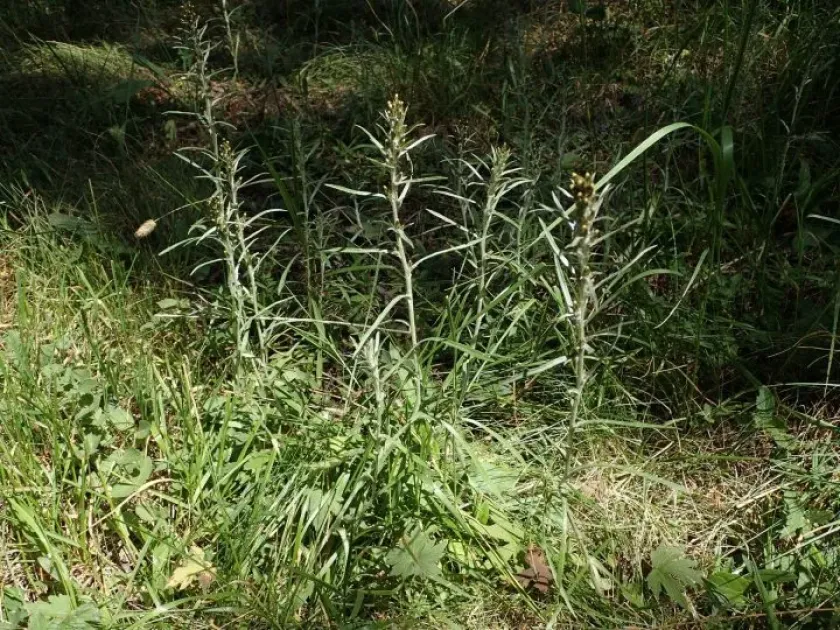
Heath cudweed (Gnaphalium sylvaticum) is a herbaceous perennial plant belonging to the Asteraceae family. It typically grows to a height of 20–50 cm with a single, erect stem.
The plant is easily identified by its dense, silvery-white woolly hairs that cover the entire surface, giving it a distinctive greyish appearance throughout its life cycle.
Its leaves are narrow, linear-lanceolate in shape, with basal leaves forming a rosette, while stem leaves are arranged alternately along the main stalk.
The inflorescence consists of small flower heads grouped in a spike-like or racemose structure at the top of the stem, featuring yellowish or brownish tubular florets.
The plant produces numerous small seeds equipped with a pappus, which allows for efficient long-distance dispersal via wind currents, facilitating rapid spread across agricultural land.
Where it grows
Heath cudweed prefers acidic, nutrient-poor soils. It is commonly found in forest clearings, heaths, clear-felled areas, and neglected pastures or fallow fields.
In agricultural settings, it predominantly invades fields with poor crop rotation or in areas where soil management practices have been neglected for several seasons.
It often establishes itself in perennial grass fields, particularly in the first year of establishment or where the crop stand is thin, allowing for light penetration.
The weed shows a preference for moisture-retaining soils, often thriving in cooler, temperate climates where forest fringes provide sheltered, moist conditions.
It can quickly colonize bare patches of soil caused by uneven application of fertilizers or soil compaction, becoming a persistent inhabitant of low-intensity fields.
Harm it causes
The main harm caused by Heath cudweed is its competition with crops for essential nutrients and moisture, especially during the critical seedling establishment phase.
By shading the soil surface and younger plants, it suppresses the growth of neighboring crops, leading to lower biomass production and reduced yield potential.
In pasture systems, its presence is detrimental as it often lacks nutritional value and is avoided by grazing livestock due to its woolly texture and bitter chemical composition.
The weed acts as a persistent seed bank contributor, where even small infestations can lead to significant management costs over time due to its prolific seed production.
Its presence indicates poor land conditions, and its ability to spread rapidly via wind can negatively affect the phytosanitary status of neighboring fields in the crop rotation.
How to control
The most effective agronomic approach is deep primary tillage, which helps bury seeds into the soil to depths where they are unable to germinate successfully.
Mechanical control through regular inter-row cultivation in row crops effectively destroys young rosettes before they develop into mature, seed-producing plants.
Chemical control can be achieved through the application of selective herbicides; however, it is essential to align the choice of chemical with the specific crop grown and local regulations.
- Implement diverse crop rotations to disrupt the weed's life cycle.
- Maintain clean field margins and prevent seed dispersal from neighboring non-arable lands.
- Use certified, weed-free seeds to prevent introduction into new areas.
- Perform timely cultivation to deplete the seed bank in the topsoil layer.
Combining mechanical methods, such as harrowing and hoeing, with carefully selected herbicide programs provides the best long-term control of this weed species.
Taxonomy
- Latin name
- Gnaphalium sylvaticum
- Family
- Сложноцветные (астровые)
- EPPO code
- GNASV