
Purple cudweed
Gamochaeta purpurea
Description
How to tell it apart
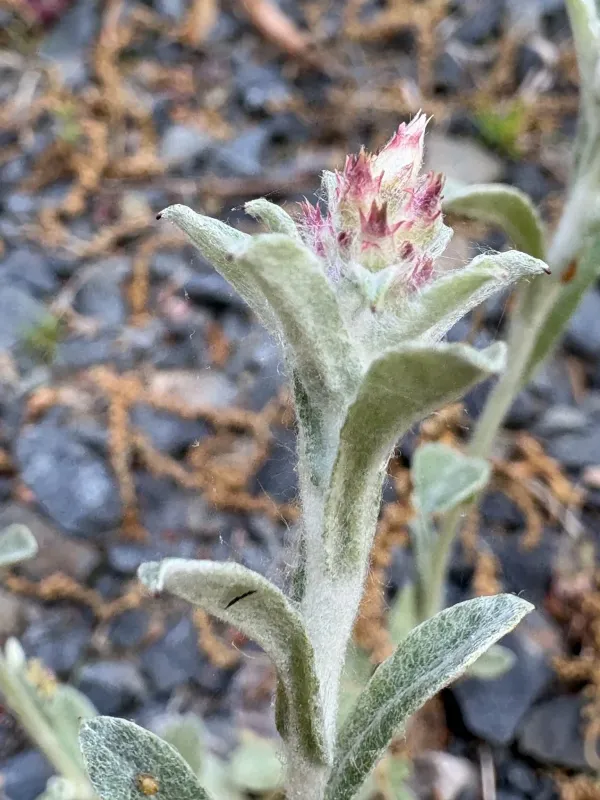
Purple cudweed (Gamochaeta purpurea) is a member of the Asteraceae family. It is an annual or biennial herb that is frequently mistaken for other members of the Gnaphalium genus due to its appearance.
The plant features an erect stem that can grow between 15 and 50 centimeters tall. Its leaves are lanceolate to spatulate, appearing dark green on the top and densely covered in white, woolly hairs on the underside.
The inflorescences consist of small flower heads clustered together at the top of the stem in a spike-like or head-like arrangement. The flowers possess a distinct purple or brownish hue, which gives the plant its common name.
The root system is fibrous and shallow, allowing the plant to establish itself quickly in compacted or nutrient-poor soils. It produces small achenes equipped with a pappus, facilitating wind-driven dispersal.
It reproduces solely by seed. These seeds can remain viable in the soil seed bank for several years, making the plant difficult to eradicate completely once it has infested an area.
Where it grows
Purple cudweed prefers open, well-lit environments. It is commonly found in disturbed sites, abandoned farmlands, pastures, and along roadsides, from where it easily colonizes agricultural fields.
In cultivated areas, it is a significant weed in row crops, vegetable gardens, and nurseries. It competes effectively with crops during their early stages of growth, depriving them of essential resources.
Due to its biological plasticity, Gamochaeta purpurea is capable of adapting to a wide range of soil conditions, ranging from dry, sandy soils to damp, heavy clay substrates.
In regions with mild climates, the plant may grow throughout much of the year, provided there are no severe frosts, allowing it to invade winter crops or early-season horticultural plantings.
On a global scale, the plant exhibits significant invasive potential, rapidly spreading through human-modified landscapes across various climatic zones.
Harm it causes
The primary damage caused by this weed is direct competition for soil nutrients and water, especially during the critical early growth phases of the crop. It grows rapidly and covers soil space.
Its presence in fields decreases the efficiency of standard mechanical cultivation, as the weed often recovers quickly from partial damage or soil loosening.
Dense clusters of the weed can shade out crop seedlings, leading to suppressed development, stunted growth, and a measurable reduction in final agricultural yield.
The plant can also act as a reservoir for certain viral and fungal diseases, which may then be transmitted to high-value crops by vectors, causing complex phytopathological issues.
Because of its high seed production, a single individual can contribute thousands of seeds to the soil bank, increasing long-term maintenance costs for farmers for years to come.
How to control
Cultural control includes frequent inter-row cultivation, which helps eliminate young rosettes before they enter the flowering stage and produce new seeds.
Implementing crop rotation is highly effective. Utilizing competitive crop species that close the canopy quickly can shade out the sun-loving Purple cudweed, preventing it from thriving.
Chemical control is effective when using systemic herbicides during the early stages of vegetation. Products based on glyphosate are typically used during pre-plant site preparation.
- Ensuring seed purity to prevent accidental spread through contaminated crop seeds.
- Deep plowing to bury seeds, which prevents them from germinating due to depth.
- Spot-spraying of selective herbicides in areas with heavy weed density.
Regular monitoring of field borders and adjacent areas is crucial to prevent the re-introduction of seeds via wind or agricultural machinery operating in infested areas.
Taxonomy
- Latin name
- Gamochaeta purpurea
- Family
- Сложноцветные (астровые)
- EPPO code
- GNAPU