
Narrow-leaf cudweed
Gamochaeta falcata
Description
How to tell it apart
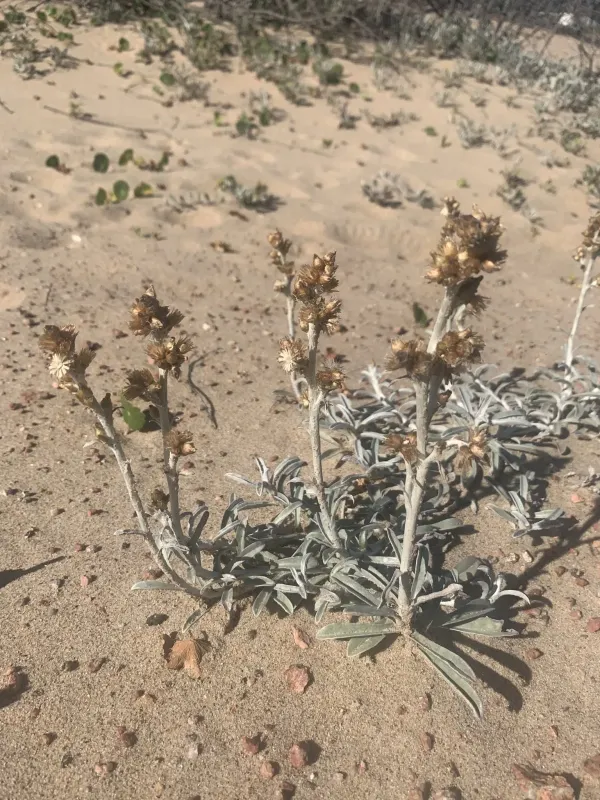
Gamochaeta falcata, commonly known as narrow-leaf cudweed, is an annual herbaceous plant belonging to the Asteraceae family.
The plant is characterized by erect or ascending stems, which are typically covered with greyish, woolly pubescence that gives the weed a distinct soft appearance.
The leaves are arranged alternately and have a narrow, lanceolate, or falcate (sickle-shaped) form, which is reflected in its specific scientific epithet.
The inflorescences consist of small flower heads grouped into dense spicate or capitate clusters at the terminal ends of the stems.
It propagates through abundant seed production, with seeds equipped with a pappus, enabling them to be dispersed over long distances by wind.
Where it grows
Narrow-leaf cudweed prefers well-lit environments and is commonly found in light, sandy, or loamy soils where competition from other vegetation is low.
It frequently inhabits abandoned agricultural lands, orchards, vineyards, roadsides, and areas with disturbed or sparse vegetation cover.
In cropping systems, it is a significant weed in row crops, particularly when cultivation between rows is delayed or poorly managed.
The weed thrives in warmer climates, demonstrating high adaptability to fluctuating moisture levels in the topsoil layer.
Uncultivated field borders often serve as reservoirs for this species, allowing for continuous re-infestation of adjacent productive farmlands.
Harm it causes
The primary damage caused by Gamochaeta falcata is the competitive suppression of crops, as it competes for water, soil nutrients, and light during the critical early stages of development.
Heavy infestations can lead to reduced plant population densities, directly impacting the final yield and overall economic efficiency of the crop production.
It acts as a potential host for various pests and pathogens, which may migrate to the primary crop, thereby increasing the risk of disease outbreaks.
The presence of this weed creates physical obstacles for harvesting machinery, leading to increased operational difficulties and potential crop losses.
Seed contamination in harvested produce significantly lowers the market value and requires additional processing and cleaning steps before sale or storage.
How to control
A fundamental agronomic control measure involves deep plowing, which buries seeds deep enough to inhibit germination and emergence of the seedlings.
Regular mechanical cultivation or hoeing of inter-row spaces during the vegetative period is highly effective in controlling the weed before it sets seed.
Implementing a sound crop rotation plan that utilizes fast-growing, canopy-closing crops helps suppress Gamochaeta falcata by denying it necessary sunlight.
Chemical control may be necessary in severe infestations, involving the application of registered post-emergence herbicides compatible with the cultivated crop.
Stringent phytosanitary measures, including the cleaning of farm equipment moving between fields, are essential to prevent the spread of seeds into non-infested areas.
Taxonomy
- Latin name
- Gamochaeta falcata
- Family
- Сложноцветные (астровые)
- EPPO code
- GNAFA