
Broad-leaved cudweed
Filago pyramidata
Description
How to tell it apart
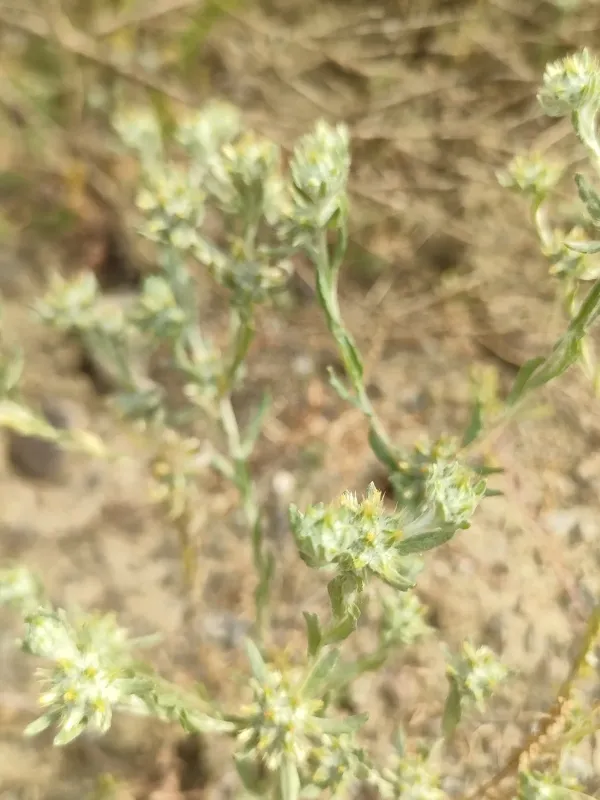
Broad-leaved cudweed (Filago pyramidata) is an annual herbaceous plant belonging to the Asteraceae family, typically categorized as a minor arable weed.
The plant is easily identified by its dense, silver-grey tomentose hairs that cover the entire stem and foliage, giving it a distinctive woolly appearance.
It is a small plant, generally ranging from 5 to 20 cm in height, with a compact, erect, or branching stem depending on the growing conditions.
The leaves are lanceolate or spatulate, arranged spirally, and closely pressed to the stem, which helps the plant retain moisture in dry habitats.
The inflorescences consist of tiny flower heads clustered in a pyramidal shape at the ends of the stems, surrounded by dry, membranous bracts.
Where it grows
This weed typically thrives in dry, sandy, or stony soils and is frequently found in nutrient-poor environments where competition is sparse.
It prefers open, sunny habitats and is commonly sighted in cultivated fields, dry pastures, roadside verges, and wasteland areas.
In agriculture, it is often seen in sparse grain crops, as it struggles to compete for light when the canopy of the main crop closes quickly.
Broad-leaved cudweed is highly adapted to regions with warm, temperate climates and is often associated with disturbed ground or fallow fields.
Its ability to germinate rapidly with minimal moisture makes it a persistent inhabitant of arid agricultural landscapes.
Harm it causes
While not a major yield-limiting weed, Broad-leaved cudweed competes for essential moisture and nutrients during the early seedling stage of crops.
The primary harm lies in its potential to colonize gaps in thin or poorly established crop stands, reducing the overall uniformity of the harvest.
Its small seeds can contaminate harvested grain, requiring extra effort and specialized equipment during the cleaning process to meet quality standards.
In pastures, it reduces the availability of space for more nutritious forage species, potentially affecting livestock grazing quality if infestations are heavy.
Presence of this plant in large numbers often acts as an indicator of stressed or poorly fertilized soil conditions that require agronomic management.
How to control
Effective control starts with good crop rotation, which ensures the crop canopy is dense enough to shade out small weeds like Filago pyramidata.
Mechanical operations such as harrowing and hoeing during the early growth stages of the crop are highly effective at uprooting young seedlings.
If chemical intervention is necessary, broad-spectrum herbicides targeting Asteraceae weeds can be applied during the early developmental phases.
Maintaining soil fertility through balanced fertilization helps the main crop establish faster, significantly reducing the success of opportunistic weeds.
Field margins and access paths should be managed to prevent seed dispersal into the production area, as the plant spreads primarily through seed production.
Taxonomy
- Latin name
- Filago pyramidata
- Family
- Сложноцветные (астровые)
- EPPO code
- FILPY