
Filago pygmaea
Filago pygmaea
Description
How to tell it apart
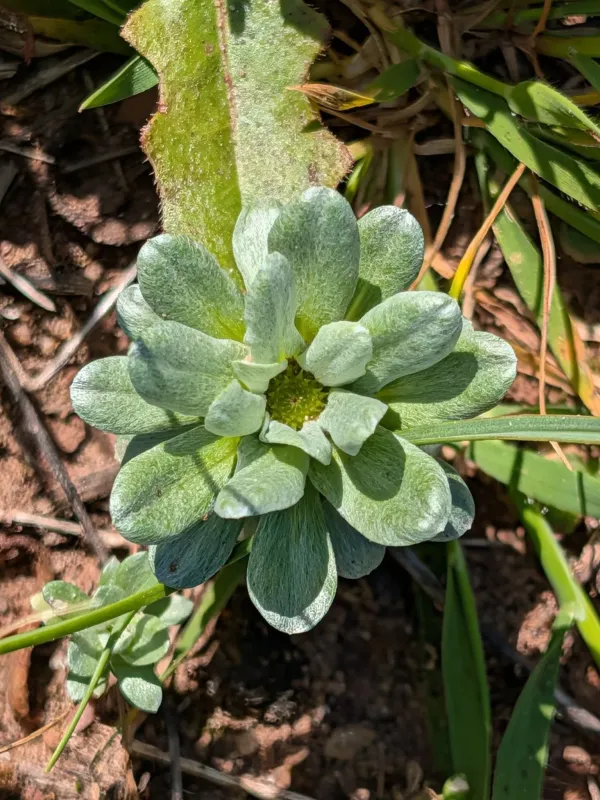
Filago pygmaea is a small annual herbaceous plant belonging to the Asteraceae family. It is characterized by its compact, low-growing habit and dense tomentose (woolly) pubescence, which gives the entire plant a grayish or silvery appearance.
The stems are highly branched, often prostrate or ascending, typically reaching a height of only 5-10 centimeters. The leaves are small, narrow, alternate, and covered in felt-like hairs, representing an adaptation to arid environments.
The flowers are clustered into tiny heads that are densely packed in the leaf axils or at the tips of the shoots. These heads are inconspicuous to the naked eye, as they are surrounded by bracts, forming specific, dense, head-like inflorescences.
Flowering occurs during the spring and summer. The plant propagates exclusively by seeds, which, due to their lightweight nature and hair-like appendages, can be dispersed by the wind over significant distances.
The root system is poorly developed, as this species is a typical xerophyte adapted to survive in nutrient-poor, sandy, or rocky soils with limited water availability.
Where it grows
This plant prefers open, sunny locations with dry, impoverished soils. It is commonly found in pastures, fallow lands, roadsides, and sand dunes within Mediterranean-type climates.
In agricultural fields, Filago pygmaea may appear in crops with sparse canopy cover or on plots with light sandy soils, where competition from main crops is reduced.
It can also colonize wasteland and stony areas adjacent to farmland, from which seeds are spread into fields during mechanized agricultural operations.
Its typical habitats are low-moisture zones where it successfully competes with other small annuals due to its ability to complete its life cycle rapidly.
Disturbed ecosystems and overgrazed land represent the most favorable environments for its aggressive colonization and the formation of persistent weed patches.
Harm it causes
The primary damage caused by Filago pygmaea lies in its ability to quickly occupy open space, displacing valuable forage grasses in pastures and reducing the overall productivity of the land.
In cereal and row crops, this weed acts as a competitor for limited soil moisture, especially during dry seasons, where even small weeds can significantly lower crop yields.
The presence of this weed in fields complicates phytosanitary monitoring, as its tiny size allows it to remain unnoticed until the onset of active seed dispersal.
The plant may serve as a reservoir for certain pathogens and pests that can subsequently migrate to cultivated crops, resulting in direct economic losses.
Infestation of fields with Filago pygmaea complicates the production of high-quality seed, requiring additional costs for cleaning and processing the harvested grain.
How to control
The foundation of controlling Filago pygmaea in agroecosystems is maintaining optimal crop density, which suppresses weed development in the early stages by creating a closed canopy.
Agronomic measures include timely cultivation and regular harrowing, which effectively destroy young weed seedlings before they reach the flowering and seed-setting stages.
Adherence to crop rotation and preventing overgrazing on adjacent lands are key factors in preventing the expansion of this species into agricultural soils.
When chemical control is necessary, broad-spectrum herbicides are used; however, their application must be strictly regulated based on the weed's growth stage and the specific crop species.
- Performing deep autumn plowing to reduce the seed bank in the soil.
- Using crop rotations that include crops that rapidly close their rows.
- Monitoring field perimeters to prevent seed infiltration from fallow areas.
Taxonomy
- Latin name
- Filago pygmaea
- Family
- Сложноцветные (астровые)
- EPPO code
- EVAPY