
Filago minima
Filago minima
Description
How to tell it apart
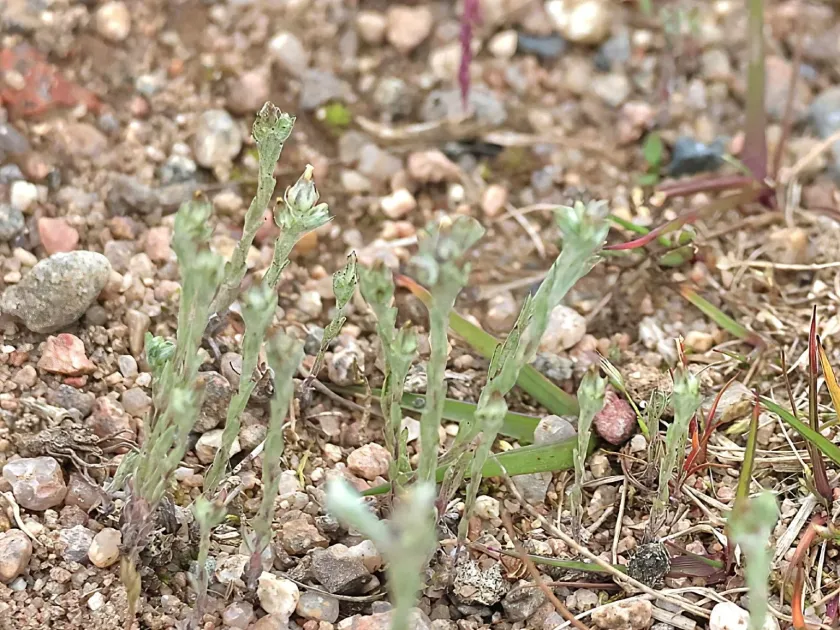
Filago minima, commonly known as small cudweed, is an annual herbaceous plant belonging to the Asteraceae family. It is a diminutive plant, typically reaching heights of only 5–15 cm, making it easy to overlook among taller crop plants.
The stem is branched from the base and covered with a dense, silvery-grey woolly tomentum. The leaves are small, alternate, and linear-lanceolate, also featuring this characteristic greyish hair covering that protects the plant from moisture loss.
The flowers are arranged in small clusters of flower heads at the tips of the branches. The heads themselves are pale yellow or whitish and surrounded by bracts. The plant possesses a taproot system, which is well-adapted to surviving in nutrient-poor soils.
Its life cycle is typical of early spring annual weeds. Reproduction is strictly by seeds, which are produced in vast quantities and are easily dispersed by wind, water, or agricultural machinery across the fields.
Identification is best achieved by looking for the distinct "felted" grey covering on all aerial parts and the specific arrangement of crowded flower heads that distinguish it from related species.
##habitat##This species favors light, sandy, or stony soils with low humus content. Filago minima is frequently found in uncultivated areas, wasteland, pine forests, and field margins where soil fertility is limited.
In agroecosystems, this weed is most problematic in winter cereal crops grown on light soils. It can also infest row crops if regular tillage or chemical intervention is absent during the early stages of crop development.
The plant shows high tolerance for moisture deficit, allowing it to colonize areas where moisture stress limits the growth of more competitive crops. Its presence is often linked to human activity and poor soil management.
In intensive farming, small cudweed often serves as an indicator of soil acidity and nutrient depletion. It quickly colonizes open patches in fields immediately after harvesting the main crop.
Because it can complete its life cycle rapidly, the weed can produce seeds even in short favorable windows, contributing to the persistent seed bank in the soil for future years.
Harm it causes
The harm caused by Filago minima lies in its competition with crops for nutrients and soil moisture, especially during the crucial early stages of crop establishment. High density can significantly suppress crop growth.
Although it does not grow very tall, its presence in high numbers can lead to reduced crop stand density. This loss of competitive advantage for the crop allows other, more aggressive weeds to invade the field.
Small cudweed may also act as a secondary host for various plant pathogens, potentially increasing the risk of diseases spreading to the primary cash crop throughout the growing season.
Nutrient uptake by the weed, while modest per plant, becomes significant in mass infestations, further depleting the upper soil horizon of essential nitrogen and minerals.
The spread of seeds during harvesting and field operations ensures the weed remains a perennial nuisance, requiring constant vigilance and consistent management strategies.
How to control
The primary control measure involves thorough soil cultivation, including deep plowing, which buries seeds and prevents them from emerging. Pre-planting tillage is also crucial for eradicating initial weed flushes.
Crop rotation incorporating vigorous, fast-growing varieties that close their canopies quickly is an effective way to shade out Filago minima and suppress its development.
Mechanical weeding through harrowing in the early stages of cereal development can successfully eliminate young weed seedlings before they develop a deep root system.
- Application of sulfonylurea herbicides in cereal crops.
- Use of hormonal herbicides (e.g., 2,4-D or MCPA) according to local regulations.
- Ensuring high purity of seed lots to prevent the introduction of weed seeds.
Chemical control must be integrated with robust agricultural practices, as the long-term viability of the seeds in the soil necessitates a multi-year management approach to achieve significant reduction.
Taxonomy
- Latin name
- Filago minima
- Family
- Сложноцветные (астровые)
- EPPO code
- FILMI