
Filago lutescens
Filago lutescens
Description
How to tell it apart
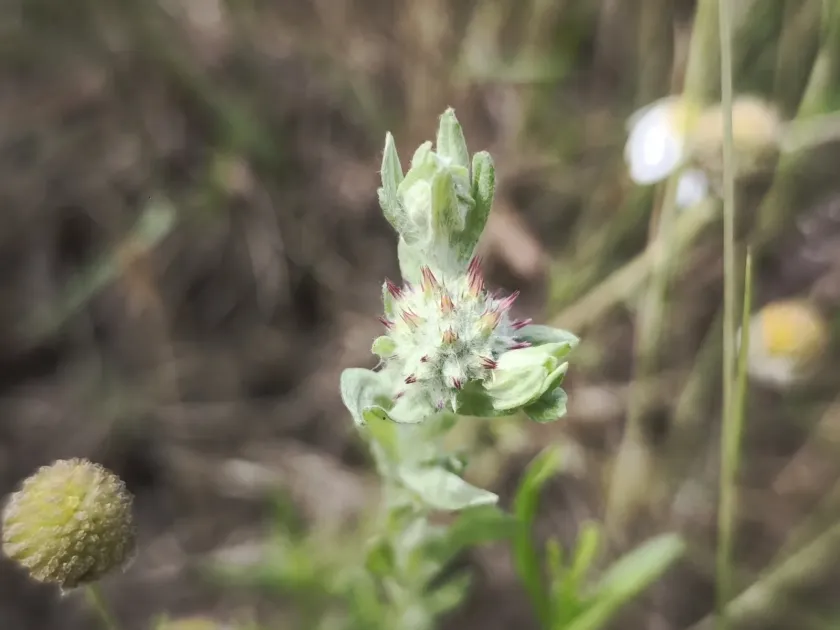
Filago lutescens, commonly known as red-tipped cudweed, is an annual herbaceous plant belonging to the Asteraceae family. It is a small plant that typically reaches a height of 10 to 20 centimeters.
The entire plant is covered with a dense, greyish or yellowish tomentose (woolly) pubescence, which gives it a distinctive pale appearance compared to other vegetation.
Its leaves are alternate, entire, and linear-lanceolate in shape. They are closely pressed to the stem, which is a structural adaptation to conserve water in arid habitats.
The flowers are arranged in small, dense heads situated at the tips of branches or in the axils of the upper leaves. The florets are inconspicuous and hidden by papery bracts.
The fruit is a tiny achene, which is easily dispersed by wind, water, or machinery across agricultural landscapes, aiding its spread as a weed.
Where it grows
This weed prefers open, sunny areas with sandy or dry, nutrient-poor soils. It is frequently found on fallow land, dry meadows, and pastures.
In farming, it invades arable fields, particularly those with low soil fertility or poor crop rotation practices where the crop canopy remains sparse.
Filago lutescens thrives in disturbed environments, often colonizing field edges, roadsides, and areas with compacted or poorly structured soil surfaces.
It is remarkably resistant to drought, allowing it to persist in regions where other weeds might fail due to lack of moisture during the growing season.
The presence of this plant is often an indicator of degraded soil quality and low humus content, suggesting a need for soil management improvements.
Harm it causes
The primary harm caused by Filago lutescens is its competition with crops for essential resources such as light and soil nutrients during the early stages of crop development.
Although an individual plant is small, dense populations can significantly deplete soil moisture, which is critical in arid or semi-arid agricultural settings.
The weed can interfere with crop establishment, causing uneven growth and potentially reducing overall yield if left unmanaged during the critical weed-free period.
By producing vast quantities of small, easily distributed seeds, the weed contributes to the long-term seed bank of the soil, making subsequent control more challenging.
Its persistence in field margins can act as a reservoir for re-infestation, leading to increased costs for herbicide application or manual labor in future seasons.
How to control
The most effective strategy against Filago lutescens is maintaining high soil fertility and fostering vigorous crop growth, which naturally outcompetes this weed.
Proper tillage operations, including deep plowing and thorough seedbed preparation, help bury seeds to depths where they are unable to germinate.
In-season mechanical control, such as inter-row cultivation in row crops, is highly effective at destroying young seedlings before they reach the flowering stage.
Chemical control can be implemented using selective herbicides, though this should be integrated with cultural practices to minimize overall chemical dependency.
- Ensure high-quality seed cleaning to prevent the introduction of weeds into new fields.
- Mow roadsides and field margins to reduce the seed rain into the crop.
- Use appropriate crop rotation to break the life cycle of the weed.
Taxonomy
- Latin name
- Filago lutescens
- Family
- Сложноцветные (астровые)
- EPPO code
- FILLU