
Filago gallica
Filago gallica
Description
How to tell it apart
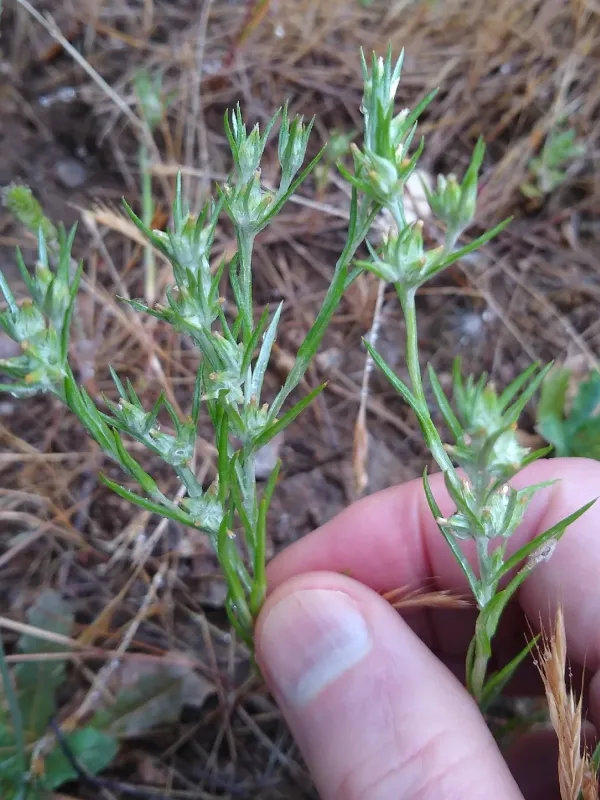
Filago gallica, commonly known as narrow-leaved cudweed, is a small annual plant belonging to the Asteraceae family. It is distinct for its silvery-grey appearance and compact growth habit.
The plant typically grows to a height of 5 to 20 cm, featuring an erect stem that branches significantly from the base, creating a bushy, localized structure.
Leaves are alternate, linear-lanceolate, and covered in fine, white, woolly hairs. This pubescence is a key feature that helps the plant survive in dry, arid conditions.
The inflorescence consists of small flower heads clustered at the tips of branches. These heads are protected by scarious bracts that give them a papery and durable texture.
The fruit is a minute achene, often equipped with a pappus, which allows for efficient wind dispersal, ensuring the weed can colonize new areas of a field very quickly.
Where it grows
Filago gallica prefers open, sunny sites with poor, sandy, or light-textured soils where competition from taller or more aggressive plant species is relatively low.
It is commonly found in fallow fields, along sandy field margins, and in winter cereal crops grown on light soils that are prone to rapid drying in the spring.
The species is widespread throughout the Mediterranean region and parts of Western and Central Europe, thriving in disturbed soils where native vegetation has been cleared.
In agricultural settings, it acts as a pioneer species on eroded patches of land, often indicating low soil fertility or poor nitrogen status within the field.
The plant is highly adaptable to changing moisture levels, which makes it a persistent issue in regions with unpredictable spring weather patterns.
Harm it causes
The primary damage caused by Filago gallica involves nutrient and water competition, especially in the early stages of crop development when the weed density is high.
While an individual plant is small, a high population density can significantly reduce the establishment and vigor of cash crops, leading to direct yield loss in the field.
The weed leaches valuable minerals from the topsoil, which is particularly detrimental in sandy soils that already possess limited buffering and nutrient-holding capacity.
Filago gallica can quickly exhaust the soil seed bank, making the land more susceptible to future infestations and complicating long-term weed management strategies.
The presence of this weed during harvest time can lead to contamination of grain samples, potentially increasing the moisture content of the harvested crop and reducing its commercial grade.
How to control
Effective management begins with proper crop rotation, integrating competitive crops that provide dense ground cover to naturally suppress the germination of weed seeds.
Mechanical operations, such as deep ploughing and regular harrowing, are effective in burying seeds deep enough to prevent emergence and destroying young seedlings before they establish.
Chemical control utilizing selective post-emergence herbicides, such as those in the sulfonylurea class, provides reliable results when applied at the correct growth stage.
Good agricultural practices, including balanced fertilization to boost crop vigor, ensure the crop can effectively outcompete the weed for essential soil nutrients.
- Monitor field edges and buffers to prevent the migration of seeds into the main production area.
- Clean farm machinery thoroughly between fields to prevent the unintentional spread of weed seeds.
- Use precise herbicide application timings to ensure maximum efficacy against the active vegetative phase of the plant.
Taxonomy
- Latin name
- Filago gallica
- Family
- Сложноцветные (астровые)
- EPPO code
- FILGA