
Field cudweed
Filago arvensis
Description
How to tell it apart
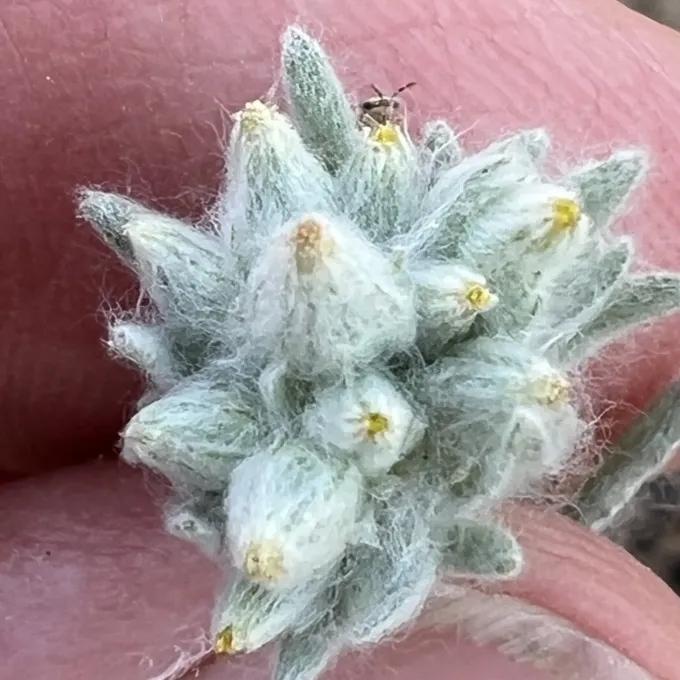
Field cudweed (Filago arvensis) is an annual herbaceous plant belonging to the Asteraceae family. It is often distinguished by its silvery-grey, woolly appearance due to dense hair covering.
The plant typically grows to a height of 5 to 30 cm. It features erect, branched stems covered in fine, appressed hairs that give the plant a felt-like texture throughout its structure.
The leaves are alternate, linear-lanceolate, sessile, and entire. Like the stems, the foliage is densely pubescent, an adaptation that helps the plant thrive in dry and exposed conditions.
Small flower heads are arranged in dense, terminal clusters that resemble spikes or heads. The plant blooms from June through August, producing tiny, wind-dispersed seeds.
The root system is a simple taproot. While effective for survival in poor soils, it is relatively shallow and vulnerable to physical mechanical disruption.
Where it grows
This species prefers dry, sandy, or stony soils. It is commonly found in arable fields, abandoned lands, pastures, and along roadsides where soil disturbance is frequent.
Field cudweed is particularly problematic in winter cereal crops, as it germinates and establishes itself before the main crop reaches its peak growth stage in the spring.
It acts as a pioneer species on degraded or nutritionally poor land, often appearing in areas with low soil fertility where competitive crops fail to cover the ground.
The weed is well-adapted to drought-prone regions and demonstrates high resilience to extreme temperatures, making it a persistent inhabitant of arid agricultural zones.
It thrives in low-density crop stands where sufficient light reaches the soil surface, allowing the seeds to germinate easily and complete their life cycle rapidly.
Harm it causes
The primary harm caused by Filago arvensis is competition with crops for limited water and essential nutrients, which is especially detrimental during early seedling development.
High levels of infestation lead to reduced crop stands, significantly negatively affecting overall grain yield and uniformity across the field.
The woolly pubescence of the plant can cause complications during harvesting, as plant parts may contaminate grain and increase the mechanical load on threshing equipment.
Field cudweed may act as a host for various agricultural pests and diseases, facilitating their spread to more sensitive economically important plant species in the vicinity.
By competing for soil surface space, it can impede the early spring warming of the soil, which is crucial for the optimal initial growth phase of winter cereals.
How to control
Effective management begins with an integrated approach, utilizing crop rotation and competitive sowing densities to suppress weed emergence and growth.
Mechanical tillage practices, such as moldboard plowing, are highly effective as they bury seeds to depths where they are unable to germinate and reach the surface.
Early spring harrowing of cereal crops is a key practice for eliminating young cudweed seedlings before they can establish a robust root system and compete with the crop.
Chemical control involving the use of sulfonylurea herbicides or growth regulator herbicides (e.g., 2,4-D or MCPA) is recommended during the tillering stage of the grain.
- Maintain high soil fertility to promote rapid canopy closure by the primary crop.
- Ensure the use of certified, high-quality, weed-free seeds for planting.
- Targeted control of field borders and non-cropped areas to prevent the spread of wind-dispersed seeds.
Taxonomy
- Latin name
- Filago arvensis
- Family
- Сложноцветные (астровые)
- EPPO code
- FILAR