
Facelis retusa
Facelis retusa
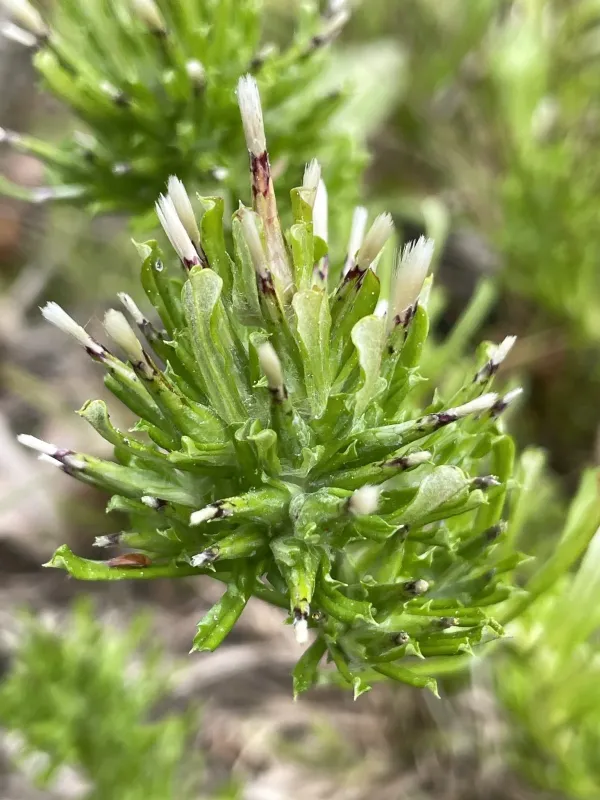
Description
How to tell it apart
Facelis retusa is an annual herbaceous plant belonging to the Asteraceae family. It typically grows as a low-lying plant, often forming dense mats or small rosettes of basal leaves.
The stems are usually branched and covered with fine, soft hairs, giving the plant a greyish appearance. The leaves are narrow, wedge-shaped or spatulate, and often feature a distinct notch at the apex, which justifies the species name "retusa".
The flowers are clustered in small, tightly held heads that often remain partially closed. The fruit is an achene equipped with a pappus, a feathery structure that allows the seeds to be easily dispersed by the wind over long distances.
The plant's lifecycle is typical of winter or early spring annuals. It completes its phenological phases rapidly, allowing it to compete effectively with crops during the early stages of vegetation.
While it may superficially resemble other members of the Asteraceae family, its specific leaf morphology and compact habit make it identifiable during standard field scouting.
Where it grows
Native to South America, Facelis retusa has become widespread as an invasive weed in warmer regions, including the southern United States, Australia, and Mediterranean countries.
It prefers sandy, loamy, or light soils with moderate moisture. The plant is highly adaptable to nutrient-poor soils, making it a significant competitor in pastures and fallow land.
The weed is frequently found in cereal crops, lawns, roadsides, and orchards. It excels at colonizing disturbed habitats, quickly occupying gaps in the vegetation.
In agricultural settings, it is a particular concern in no-till or minimum-tillage systems where seeds remain near the surface, facilitating rapid germination in the topsoil horizon.
Due to its efficient seed production, the weed builds a persistent soil seed bank, which complicates eradication efforts even after repeated mechanical clearing.
Harm it causes
The primary damage caused by Facelis retusa stems from its high competitiveness for nutrients, water, and sunlight, particularly during the critical growth stages of main crops.
In forage and cereal fields, the weed can significantly reduce yields by capturing nitrogen and moisture, which is especially detrimental during dry spring seasons.
Its ability to rapidly colonize bare spaces allows it to outcompete valuable forage grasses in pastures, thereby reducing the nutritional value of the land for livestock.
Mass infestations of the weed can interfere with mechanical harvesting, as the excessive vegetative biomass can clog agricultural machinery.
The presence of this species necessitates additional expenditure on phytosanitary measures, leading to increased overall production costs.
How to control
Agricultural management strategies involve mandatory crop rotation with species that have dense canopies, which help suppress the weed through shading.
Mechanical cultivation remains a highly effective method: deep plowing buries the seeds to depths where germination is biologically hindered.
Managing field margins and adjacent areas is crucial to prevent wind-borne seed dispersal onto cultivated land.
- Application of broad-spectrum herbicides during the active growth phase of the weed.
- Use of selective herbicides, such as sulfonylureas, where registered for specific crop safety.
- Timely mowing or tillage before seed set to exhaust the soil seed bank over time.
Chemical control is most effective during the seedling or early rosette stage, as the plant is more susceptible to active ingredients before it develops a robust root system.
Taxonomy
- Latin name
- Facelis retusa
- Family
- Сложноцветные (астровые)
- EPPO code
- FACAP