
Coastal Joe-Pye weed
Eutrochium dubium
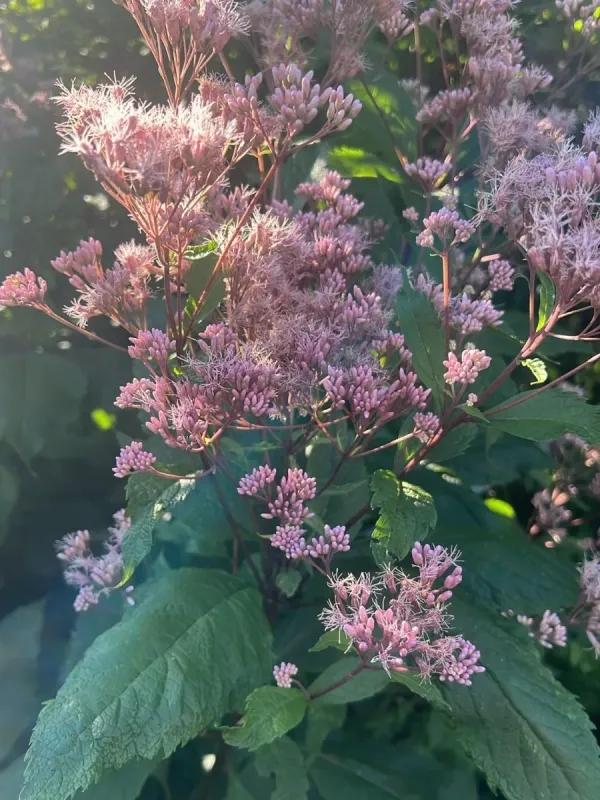
Description
How to tell it apart
Coastal Joe-Pye weed is a member of the Asteraceae family. It is a tall herbaceous perennial, typically growing from 2 to 5 feet high, with stems that are often spotted with purple.
The leaves are arranged in whorls of 3 to 4 along the stem. They are lance-shaped, finely serrated along the edges, and feature prominent veins, distinguishing them from similar species.
Flowers appear in late summer as large, showy, flat-topped clusters or panicles. These clusters are composed of numerous small, pale pink to light purple florets that attract pollinators.
The plant grows from a tough, fibrous rootstock. This perennial structure allows it to survive through winter and regrow vigorously each spring from the existing root system.
Seeds are equipped with a feathery pappus, enabling them to be dispersed effectively by wind currents. This rapid colonization strategy allows it to spread into new areas quickly.
Where it grows
This species is naturally found in moist to wet habitats. It thrives in wetlands, swamps, damp meadows, and along the edges of ponds or slow-moving streams.
In agricultural settings, it is often seen in poorly drained fields, irrigation ditches, or near watercourses where the soil remains consistently moist throughout the growing season.
The plant is highly adaptable to wet soil conditions where many other species would struggle. It frequently establishes itself in uncultivated margins and semi-wetlands on farmland.
It prefers high organic matter content in the soil. Its presence is a strong indicator of localized water accumulation or a potential failure in the field drainage system.
While it is rarely a problem in dry, well-tilled fields, it can become invasive in nursery settings, greenhouse peripheries, and low-lying pastures where moisture is abundant.
Harm it causes
Coastal Joe-Pye weed competes intensely with crops for water and mineral nutrients. In dense patches, it can significantly reduce the growth and yield of surrounding plants.
The plant's height and dense foliage create significant shading, which can suppress young crops and inhibit their development during the early stages of the growing season.
It acts as a potential host for various pests and fungal pathogens, which can then spread to cultivated crops, increasing the overall phytosanitary risk on the farm.
Presence in large numbers can interfere with harvesting and other mechanical farm operations, as the thick, tough stems can jam equipment or obstruct work paths.
If left unmanaged, its aggressive root system can make land reclamation difficult and expensive, necessitating significant soil work to restore the field to optimal productivity.
How to control
Mechanical control involves the complete removal of the root system. Deep tilling or manual digging is necessary to ensure the entire crown and rhizomes are extracted from the soil.
Consistent mowing throughout the season is effective at weakening the root system. By preventing the plant from photosynthesizing, you starve the roots over time.
Improving field drainage is the most sustainable approach to control. By lowering the water table or removing standing water, the habitat becomes unsuitable for the plant's growth.
Chemical control using systemic herbicides (such as glyphosate-based products) is best applied during the active growth phase, specifically before or at the onset of flowering.
For large infestations, a combination of mowing followed by spot treatments with selective herbicides is recommended to manage the weed without harming beneficial vegetation.
Taxonomy
- Latin name
- Eutrochium dubium
- Family
- Сложноцветные (астровые)
- EPPO code
- EUPDU