
Tall thoroughwort
Eupatorium altissimum
Description
How to tell it apart
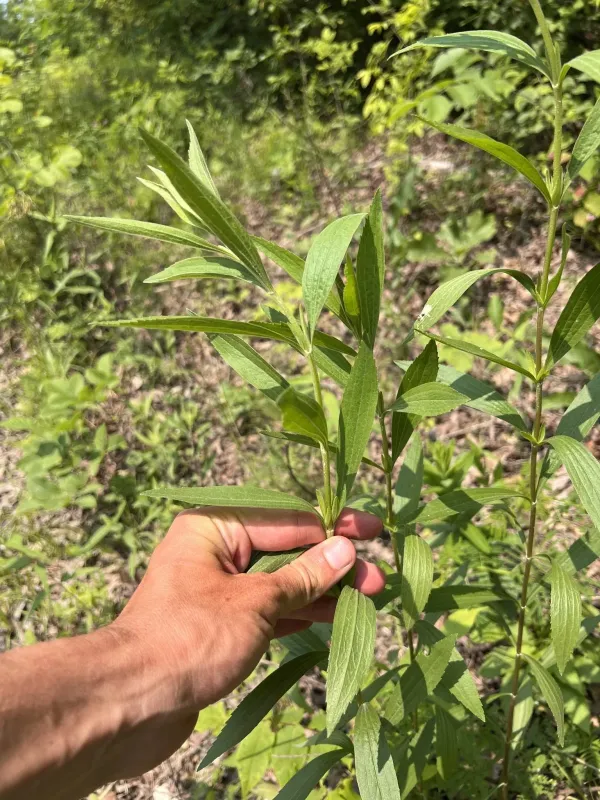
Tall thoroughwort (Eupatorium altissimum) is a perennial herbaceous plant belonging to the Asteraceae family. The plant is characterized by erect, densely pubescent stems that can reach heights ranging from 60 to 150 centimeters.
The leaves are lanceolate or linear-lanceolate, typically featuring three prominent veins, which serves as a reliable diagnostic trait. The leaf margins are finely serrated, and the foliage exhibits a grayish-green hue due to fine hair covering the surface.
The inflorescences are arranged in complex corymbs, consisting of numerous small flower heads. The flowers are white to off-white, distinguishing this species from other thoroughwort varieties that often display pinkish blooms.
The plant possesses a robust root system consisting of short rhizomes, enabling significant vegetative reproduction. The seeds are equipped with a pappus, which aids in efficient wind dispersal over long distances.
While the plant is entomophilous and supports various pollinators, it functions as a highly aggressive competitor in agricultural fields, rapidly claiming available space and nutrients.
Where it grows
Native to North America, Tall thoroughwort is commonly found in prairies, meadows, and along roadsides. It thrives in well-lit areas with moderately moist, nutrient-rich soils, showing high adaptability to diverse environments.
In agricultural settings, it frequently invades fallow land, pastures, and fields left uncultivated for extended periods. Its ecological plasticity allows it to establish itself effectively in various soil types, ranging from sandy to heavier textures.
Once established in grain or row crop fields, it forms dense colonies that outcompete desired crops. Its high seed production ensures rapid colonization of adjacent areas, making control in field margins critical.
The species demonstrates good tolerance to drought conditions, allowing it to compete effectively for water resources during dry spells. In human-disturbed habitats, it actively colonizes degraded areas, creating persistent infestations.
Field margins, drainage ditches, and fence rows often serve as permanent reservoirs, facilitating the spread of seeds into active agricultural production areas.
Harm it causes
The primary damage caused by Tall thoroughwort is competition for essential resources including sunlight, water, and soil nutrients. Due to its vigorous spring growth, it significantly suppresses crop development, leading to reduced yields.
In pastures, it is considered an undesirable species because of its low forage quality and potential unpalatability to livestock, driven by its chemical composition.
The strong rhizomatous root system makes mechanical tillage difficult. In perennial hay crops, the weed tends to dominate, lowering the overall nutritive value and quality of the harvested biomass.
Tall thoroughwort can serve as an alternative host for various plant pathogens, potentially increasing the disease pressure on surrounding agricultural crops.
The presence of this weed necessitates additional herbicide applications and labor-intensive manual weeding, which directly increases the overall cost of agricultural production.
How to control
Mechanical control focuses on systematic deep tillage, which is effective in exhausting the rhizome reserves. It is crucial to perform tillage or mowing before the flowering stage to prevent seed set and subsequent dispersal.
Crop rotation incorporating diverse life cycles is recommended to create unfavorable conditions for the establishment of this perennial weed. Regular mowing in non-cropped areas can significantly limit its reproductive capacity.
Chemical control involves the use of systemic herbicides. Glyphosate-based products are typically used for site preparation or in fallow fields to ensure translocation into the rhizomes and complete plant destruction.
In growing crops, selective herbicides aimed at broadleaf weed control are employed. The choice of active ingredient must align with the growth stage of the thoroughwort and the specific crop safety requirements.
- Early detection and isolation of infestation patches.
- Strategic timing of soil cultivation to maximize suppression.
- Integrated management combining mechanical and chemical measures.
Taxonomy
- Latin name
- Eupatorium altissimum
- Family
- Сложноцветные (астровые)
- EPPO code
- EUPAT