
Japanese cudweed
Euchiton japonicus
Description
How to tell it apart
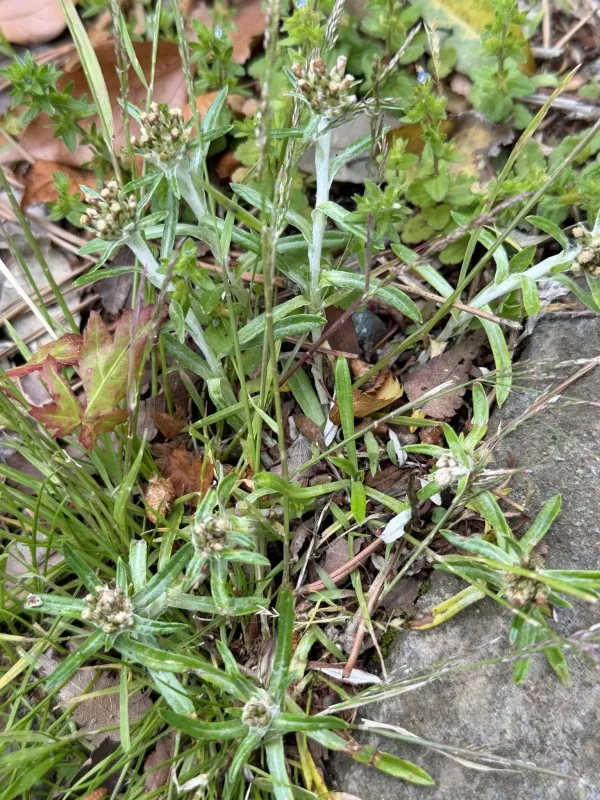
Japanese cudweed (Euchiton japonicus) is a perennial or biennial herbaceous plant belonging to the Asteraceae family. It is easily identified by its dense, silvery-white woolly hair covering the entire plant, giving it a characteristic grey appearance.
The stems are erect or ascending, usually reaching 15–40 cm in height, and often branching near the upper part where the inflorescences develop. The leaves are linear-lanceolate, alternate, and frequently have margins that roll downwards.
Its inflorescences consist of small, dense flower heads arranged in corymbose or spike-like clusters. The flowers are tubular and hidden by brownish or yellowish papery bracts, which are key diagnostic features.
The root system is fibrous and quite extensive, allowing the weed to anchor itself firmly and compete effectively for resources in disturbed soils.
Each plant produces numerous tiny seeds equipped with a feathery pappus, enabling them to be easily dispersed over large distances by wind currents.
Where it grows
Japanese cudweed is native to Eastern Asia, including Japan, Korea, and parts of Russia's Far East, where it thrives in open, disturbed habitats with exposed soil.
It is frequently observed growing along roadsides, field margins, abandoned pastures, and areas affected by soil erosion, where it quickly establishes itself.
In agricultural settings, it commonly appears in cereal crops, vegetable rotations, and forage fields, often colonizing areas where crop density is insufficient to suppress weeds.
The plant prefers well-lit environments and is highly adaptable, often persisting in field borders and uncultivated patches from which it spreads into active fields.
Due to its resilience, the seeds can remain viable in the soil for several years, allowing the weed to re-emerge whenever favorable conditions arise in the crop rotation cycle.
Harm it causes
The harmful impact of Japanese cudweed is primarily due to its aggressive competition for water and soil nutrients, which negatively affects the development of crops during critical growth stages.
High levels of infestation lead to reduced crop stands, as the weed can outcompete young seedlings for space and light, ultimately resulting in significant yield losses.
The dense cover formed by the weed inhibits photosynthesis in crops by shading, causing stunted growth and lower biomass accumulation in the main field crops.
Furthermore, Japanese cudweed acts as a host for various fungal diseases and pests, serving as a reservoir that allows pathogens to move into cultivated areas during the growing season.
Presence of this weed in the harvested crop degrades the quality of produce, requiring additional post-harvest processing steps to remove impurities and ensure market-grade quality.
How to control
Effective management begins with sound crop rotation practices that include competitive crops that can naturally shade out weeds, such as dense cereal or forage stands.
Mechanical control measures involve deep ploughing and regular harrowing to destroy the weed's root system and to trigger the germination of dormant seeds for later eradication.
Sanitation of field borders, irrigation ditches, and nearby waste areas is essential to prevent the influx of wind-dispersed seeds into the main production fields.
Chemical control via selective herbicides is highly effective when applied during the early vegetative growth phase of the weed, before it enters the flowering stage.
Combining herbicides with integrated agricultural practices, such as optimizing fertilization and seeding rates, is the most sustainable approach to keeping Japanese cudweed below economic injury thresholds.
Taxonomy
- Latin name
- Euchiton japonicus
- Family
- Сложноцветные (астровые)
- EPPO code
- GNAJA