
Brazilian fireweed
Erechtites valerianifolius
Description
How to tell it apart
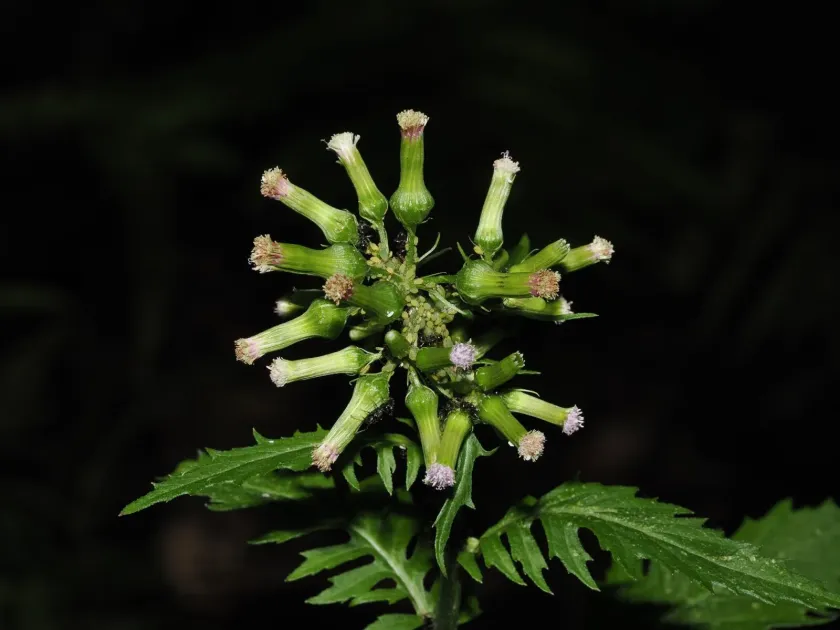
Erechtites valerianifolius, commonly known as Brazilian fireweed, is an annual herbaceous plant belonging to the Asteraceae family. Its stems are upright and can grow to a height of 50 to 150 centimeters.
The plant is characterized by its serrated, pinnately lobed leaves, which resemble the foliage of a valerian plant, hence the scientific name assigned to the species.
Its inflorescences are composed of many flower heads grouped in a loose, branched panicle. The tiny florets are typically yellowish or reddish-brown in color.
The seeds are small and equipped with a white pappus (bristles), which allows them to be wind-dispersed over vast distances, facilitating rapid colonization of new habitats.
The root system is fibrous and quite extensive, enabling the plant to compete effectively for nutrients and water in various soil environments.
Where it grows
Brazilian fireweed thrives in moist, fertile soils and is commonly found in disturbed areas, forest clearings, abandoned agricultural land, and along roadsides.
In agricultural settings, it often invades row crops, particularly in warm, humid climates where rapid growth allows it to overshadow developing seedlings.
The species is highly adaptable and can establish itself quickly on lands that have been recently cleared or exposed, taking advantage of lack of competition.
It frequently populates irrigated agricultural zones and river banks, where moisture levels are consistently high, supporting its aggressive growth patterns.
Due to its high seed production, it can quickly become the dominant weed species in a field if early preventative measures are ignored or neglected.
Harm it causes
The primary damage caused by Erechtites valerianifolius is the intense competition for resources, which significantly reduces the vigor and yield of agricultural crops.
Its rapid biomass production allows it to shade out smaller crops, hindering their ability to perform photosynthesis and reducing overall productivity.
By consuming substantial amounts of nitrogen and other essential nutrients from the soil, the weed deprives crops of the nutrition needed for healthy development.
Presence of this weed increases production costs as it requires additional interventions, such as intensive mechanical weeding or chemical treatment.
Furthermore, it can act as an alternative host for various pests and diseases that affect commercial crops, creating a secondary risk for the farm.
How to control
Mechanical control involves cutting or mowing the plants before they reach the flowering stage to prevent the production and dispersal of seeds.
Effective tillage practices, such as deep plowing and regular inter-row cultivation, are essential to destroy seedlings and bury dormant seeds, preventing emergence.
Chemical control can be achieved by applying selective herbicides designed to target broadleaf weeds, ensuring the product is applied at the correct growth stage.
Integrating crop rotation and maintaining high crop density can help create a canopy that shades the ground and suppresses the germination of fireweed seeds.
Sanitation of field borders and adjacent non-crop areas is vital to prevent wind-borne seeds from re-entering treated agricultural plots.
Taxonomy
- Latin name
- Erechtites valerianifolius
- Family
- Сложноцветные (астровые)
- EPPO code
- EREVA