
Coast fireweed
Erechtites minima
Description
How to tell it apart
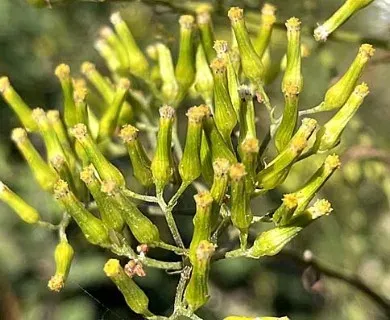
Coast fireweed (Erechtites minima) is a herbaceous annual plant belonging to the Asteraceae family. It is often misidentified as a type of groundsel due to its flower structure.
The plant grows upright, reaching heights of up to 1.5 meters. The stems are typically ribbed, sometimes exhibiting a reddish hue, and can be either branched or simple.
Its leaves are alternate, lanceolate, and have serrated margins. Lower leaves are generally larger and more prominent than the upper, narrower ones.
The inflorescence consists of numerous small flower heads arranged in a loose panicle. The flowers are mostly disc-shaped, yellowish-white, and lack showy ray florets.
Seeds are equipped with a white pappus, allowing for wind dispersal across significant distances, which facilitates the rapid colonization of new habitats.
Where it grows
Coast fireweed is considered an invasive weed that thrives in disturbed environments, such as forest clearings, roadsides, and agricultural lands.
In agricultural settings, it frequently infests row crops, orchards, and vegetable farms, where it exploits open spaces and bare ground caused by cultivation.
The plant is highly adaptable to various soil types and is often one of the first species to colonize areas after fires or major mechanical soil disruption.
It occupies ecological niches where competition is low, growing vigorously and producing thousands of seeds per plant to ensure successful reproduction.
Its spread is exacerbated by human activity, including the movement of contaminated farm machinery, soil, and vehicles between different fields.
Harm it causes
The primary damage caused by Coast fireweed is the intense competition for sunlight, as its rapid vertical growth easily shades out slower-growing crops.
It acts as a strong competitor for soil nutrients and moisture, significantly reducing the vigor and potential yield of the affected primary crops.
Coast fireweed exhibits allelopathic properties, releasing chemical substances into the soil that can inhibit the germination and growth of neighboring plant species.
Large infestations interfere with standard agricultural operations, including mechanical weeding, fertilizer application, and harvesting, thereby increasing production costs.
Contamination of harvested grain with fireweed seeds reduces quality, necessitating additional processing and lowering the overall market value of the product.
How to control
Effective management begins with mechanical control, such as deep plowing, which buries seeds and prevents them from reaching the necessary light to germinate.
Timely cultivation between crop rows is essential to eliminate young seedlings before they develop a deep root system or reach the flowering stage.
Chemical control can be implemented using selective herbicides, which are most effective when applied at the very early stages of weed development.
Implementing a diverse crop rotation cycle that includes cover crops helps smother the weed by outcompeting it for space and light resources.
- Regular field scouting to identify and treat early outbreaks.
- Ensuring the use of certified, weed-free seed stock.
- Thorough cleaning of equipment after working in infested areas.
- Mowing field edges to prevent seeds from blowing into crop areas.
Taxonomy
- Latin name
- Erechtites minima
- Family
- Сложноцветные (астровые)
- EPPO code
- EREPR