
Kellogg's tarweed
Deinandra kelloggii
Description
How to tell it apart
Deinandra kelloggii, commonly known as Kellogg's tarweed, belongs to the Asteraceae family. It is an annual herbaceous plant often found in disturbed landscapes.
The plant typically grows from 10 to 80 centimeters tall, featuring branching stems covered in glandular hairs. These hairs give the plant a sticky texture and a distinct resinous scent.
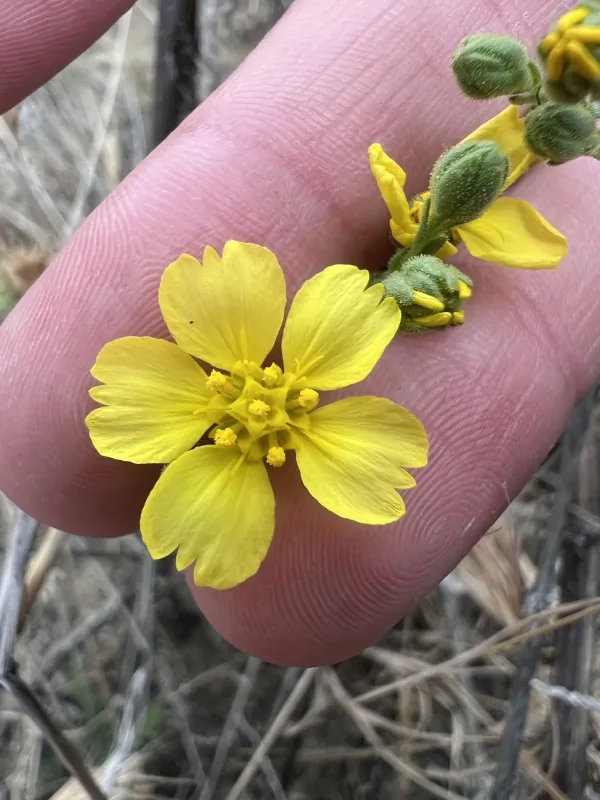
Leaves are narrow and linear, arranged alternately along the stem. The plant produces yellow flower heads that bloom during the warmer months of the year.
It is characterized by its resilience and ability to thrive in poor soils, quickly establishing itself where other vegetation has been disturbed or removed.
Identification is easiest during the flowering stage, as the yellow daisy-like flowers and sticky stems are distinct markers for this species in the field.
Where it grows
The species is primarily native to regions in the western United States, particularly California. It favors open areas, grasslands, and damaged ecosystems.
In agricultural settings, it frequently infests crop fields, pastures, and fallow lands. It is well-adapted to Mediterranean climates where summers are dry and hot.
Kellogg's tarweed is often found along roadsides, field margins, and neglected farm areas, which serve as reservoirs for its wind-dispersed seeds.
Soil disturbance caused by heavy machinery often creates the ideal conditions for the rapid germination of seeds that have been lying dormant in the soil bank.
It can tolerate a range of soil types, including clay and rocky ground, making it a persistent guest in diverse agricultural landscapes.
Harm it causes
The primary damage caused by this weed is the intense competition for soil moisture, which can severely stress neighboring crops, especially in drought-prone regions.
Its sticky, resinous foliage can interfere with harvesting equipment, potentially clogging machinery and reducing the overall efficiency of agricultural operations.
High seed production leads to heavy contamination of harvested grain, which may result in lower market value and increased costs for cleaning and processing.
In livestock pastures, the plant is often avoided by cattle due to its resinous content, which decreases the available forage quality and total grazing capacity.
As a persistent weed with a long-lived seed bank, it necessitates ongoing management efforts to prevent it from becoming the dominant vegetation in a field.
How to control
Integrated weed management is key. Proper tillage practices before seed set are essential to disrupt the reproductive cycle and prevent further spread.
Crop rotation with competitive, dense-canopy plants can naturally shade out the tarweed, reducing its ability to establish successfully during the early growing stages.
Chemical control involving selective herbicides can be applied during the early growth phases to effectively suppress population levels before the plant becomes woody.
Sanitation of agricultural machinery is a critical preventive measure, as seeds can easily adhere to tires and equipment, facilitating spread between different fields.
- Regular field scouting to detect early infestations.
- Mechanical mowing or removal before flowering occurs.
- Strategic use of registered herbicides for field crops.
- Maintaining clean field borders to reduce seed migration.
Taxonomy
- Latin name
- Deinandra kelloggii
- Family
- Сложноцветные (астровые)
- EPPO code
- HEZKE