
Deinandra fasciculata
Deinandra fasciculata
Description
How to tell it apart
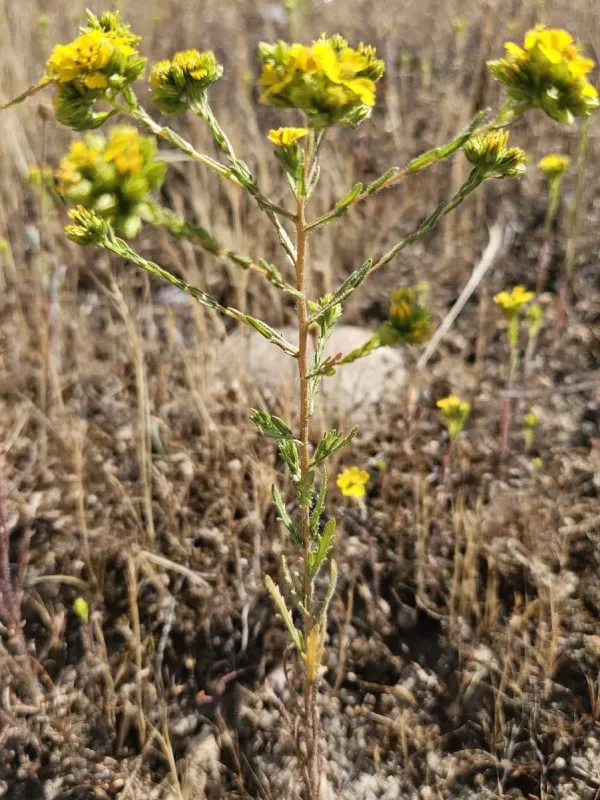
Deinandra fasciculata, commonly known as clustered tarweed, is an annual herb within the Asteraceae family. Its name reflects its clustered, branching growth pattern.
The plant features narrow, linear leaves often covered in sticky, glandular hairs that produce a distinct resinous, tar-like odor. It can reach heights of up to 80 centimeters.
The flowers are small yellow heads grouped in dense, terminal panicles. These bright blooms make the plant highly visible in meadows and fields during late spring and summer.
As a biological adaptation to drought, the plant is covered in trichomes that reduce transpiration and give it a characteristic sticky texture.
The seeds are small and light, facilitating rapid dispersal by wind across open fields, which contributes to its status as a prolific colonizer.
Where it grows
Deinandra fasciculata is native to California and typically thrives in open grasslands, disturbed soils, pastures, and along roadsides where competition from perennials is low.
In agricultural settings, it frequently invades grain fields and fallow lands. It is particularly persistent in Mediterranean climates with distinct wet and dry cycles.
The plant is highly resilient to soil moisture deficits, often appearing in fields where the crop stand has been compromised by drought or poor land management.
It prefers well-drained, sandy, or rocky soils and can easily occupy abandoned agricultural lands, making it a common sight in marginal areas.
Its invasive nature allows it to establish dense stands quickly, effectively outcompeting native grasses and small seedlings in newly disturbed areas.
Harm it causes
The primary agricultural harm caused by clustered tarweed is extreme competition for soil moisture, which is often a limiting factor in arid farming regions.
In grazing lands, it serves as a poor forage source; livestock often avoid it due to its pungent, tarry secretions, leading to a decrease in overall pasture utility.
During the harvest season, the mature, woody, and sticky stems can clog mechanical harvesters, leading to equipment downtime and increased maintenance requirements.
The presence of its seeds in harvested crops can contaminate grain samples, reducing market value and necessitating costly separation processes.
Furthermore, it can act as a secondary host for various agricultural pests, providing shelter and sustenance during the off-season for harmful insect populations.
How to control
Effective control starts with cultural practices like deep tillage, which buries seeds and disrupts the root development of young seedlings before they branch.
Maintaining a healthy, dense crop cover through proper seeding rates and fertilization helps outcompete the weed, preventing it from establishing a foothold.
Manual removal or cultivation is most effective during the seedling stage before the plant develops its thick, woody root system and glandular foliage.
Chemical control involving selective herbicides is recommended for large infestations. Application should target the early rosette stage for maximum efficacy.
- Regular mowing of field margins to prevent seed set.
- Integrated weed management programs including crop rotation.
- Strategic application of post-emergence herbicides on fallow land.
Taxonomy
- Latin name
- Deinandra fasciculata
- Family
- Сложноцветные (астровые)
- EPPO code
- HEZFA