
Buttonweed
Cotula coronopifolia
Description
How to tell it apart
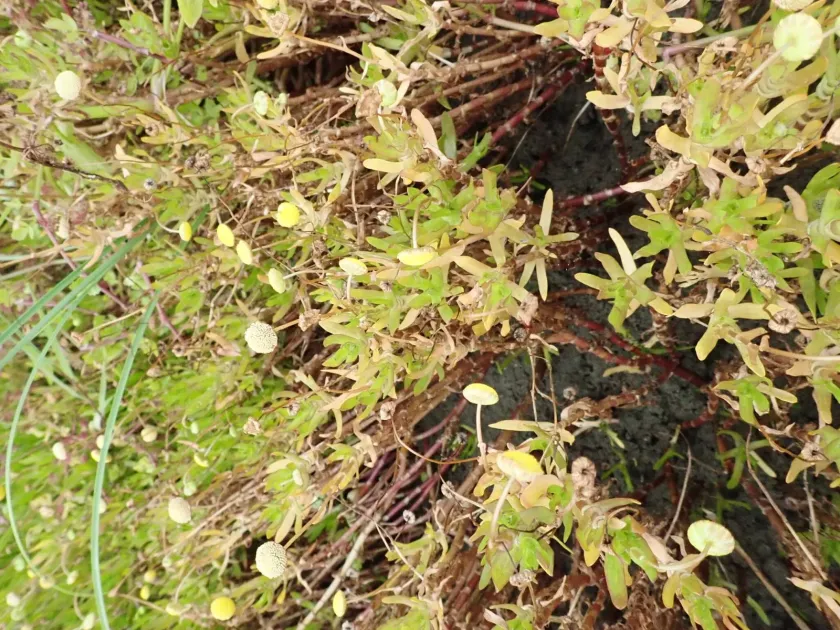
Cotula coronopifolia, commonly known as buttonweed or brass buttons, is a plant belonging to the Asteraceae family. It is a fleshy, prostrate, or decumbent herb that typically grows 10–40 cm in height.
The leaves are alternate, succulent, and often pinnately lobed or entire, with sheathing bases that clasp the stem. This succulent structure is an evolutionary adaptation to saline and wet environments.
The flowers are solitary, bright yellow, disc-like heads that lack ray florets, giving them the distinct appearance of a small yellow button, which explains its common name.
The root system is fibrous and capable of rooting at the nodes, allowing the plant to spread vegetatively across damp substrates, creating dense colonies that are difficult to eradicate.
This species is highly adaptable, exhibiting both annual and perennial growth habits depending on the environmental conditions and the availability of water in the soil.
Where it grows
Buttonweed thrives in wet, marshy habitats. It is commonly found along the margins of lakes, ponds, riverbanks, and in salt marshes where other plants struggle to survive.
In agricultural settings, it is a significant weed in irrigated crop systems, particularly in rice paddies and poorly drained fields where moisture levels remain consistently high.
It readily colonizes irrigation ditches and drainage systems. By obstructing water flow, it indirectly impacts the efficiency of water management infrastructure on farms.
The plant demonstrates a high tolerance to soil salinity, often becoming a dominant weed in reclaimed coastal lands or areas affected by waterlogging and secondary salinization.
It spreads efficiently via seed dispersal through water currents and mechanical transport, rapidly establishing itself in any disturbed site with adequate moisture levels.
Harm it causes
The primary harm caused by Cotula coronopifolia is its intense competition for space, water, and nutrients, which significantly stunts the growth of crop seedlings.
In rice farming, its rapid colonization of paddies suppresses the crop's development, leading to reduced tillering and lower overall grain yields at the end of the season.
Large infestations interfere with mechanical field operations. The dense, fleshy stems can clog harvesting machinery and tillage equipment, causing significant downtime for farmers.
The weed serves as a host for various pathogens and pests that can transition to neighboring crops, thereby necessitating more frequent and costly chemical treatments.
On pasture lands, its presence reduces the quality and palatability of forage, as it often displaces more nutritious grasses, impacting livestock productivity.
How to control
Effective management begins with improving field drainage. Reducing surface water accumulation is the most sustainable method to suppress buttonweed establishment.
Mechanical control involves deep tillage and precise inter-row cultivation. These practices disturb the shallow root system of the weed and prevent vegetative spread during the early growth phase.
Chemical control is feasible using systemic herbicides. Applications should be timed when the weed is in the active rosette stage to ensure maximum translocation of the active ingredient.
Sanitation of irrigation networks is crucial. Controlling infestations along the banks of ditches prevents the spread of seeds into the main production fields via irrigation water.
- Improve soil drainage and water management.
- Perform timely mechanical cultivation.
- Use selective herbicides for broadleaf weeds.
- Monitor and treat ditches and irrigation channels.
Taxonomy
- Latin name
- Cotula coronopifolia
- Family
- Сложноцветные (астровые)
- EPPO code
- CULCO