
Centaurea uniflora
Centaurea uniflora
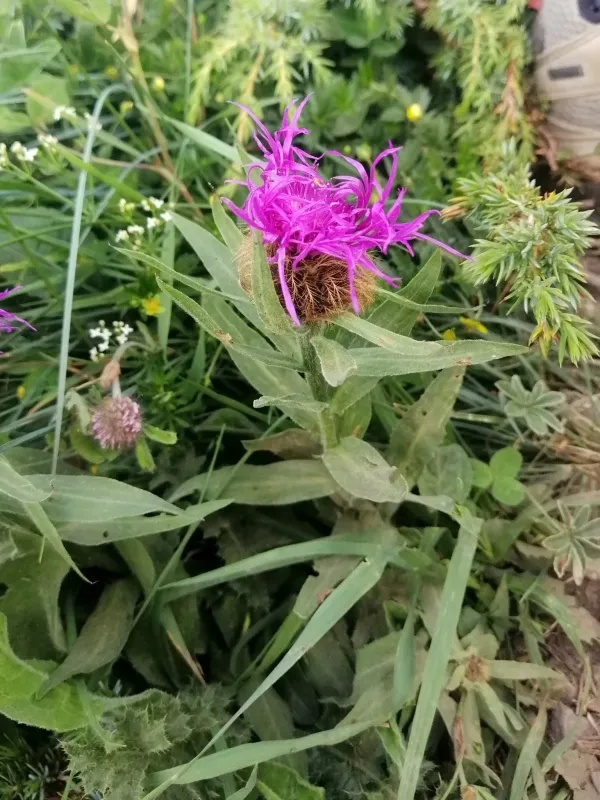
Description
How to tell it apart
Centaurea uniflora belongs to the Asteraceae family and is recognized as a perennial herbaceous plant with a single, non-branched stem topped by a prominent flower head.
The most distinct feature of this species is the presence of long appendages on the bracts, which almost entirely enclose the flowers, giving the inflorescence a cobweb-like appearance.
The foliage typically consists of entire, lanceolate leaves arranged in a basal rosette, providing a robust base for the plant to thrive across different seasons.
Its root system is well-developed, allowing the plant to remain dormant during winter and re-emerge rapidly when favorable conditions return in the spring.
Plants generally reach a height of 20 to 50 centimeters, growing in dense clumps that make them easily distinguishable from surrounding low-growing vegetation.
Where it grows
This weed primarily inhabits mountainous meadows, stony slopes, and forest edges, though it frequently spreads into adjacent agricultural lands.
It is commonly found in pastures, fallow fields, and permanent grasslands where minimal soil disturbance allows it to establish long-term populations.
The species is highly adaptable, preferring well-drained, moderately moist soils but demonstrating resilience in various environmental conditions.
While it is less problematic in intensive annual grain fields, it poses a significant threat in semi-natural areas and field margins, acting as a source for expansion.
Its dual ability to spread via seed dispersal and vegetative regrowth makes it a persistent threat in neglected agricultural areas or low-input systems.
Harm it causes
The primary economic impact stems from its competitive nature, as it rapidly consumes water and nutrients, effectively suppressing the growth of neighboring crops.
Contamination of harvested material is a major issue, as its seeds are difficult to separate from cereal or forage crops, thus reducing the market quality of the yield.
In grazing environments, the plant is considered a nuisance because its tough stems and prickly bracts make it unpalatable and reduce overall pasture biomass.
The plant exhibits allelopathic properties, releasing compounds into the soil that inhibit the germination and development of competing crop species.
Dense clusters of this weed can physically interfere with harvesting machinery and necessitate increased cleaning operations for harvested grain or hay.
How to control
Deep plowing and regular soil cultivation are essential mechanical methods to disrupt the root systems and prevent the establishment of deep-seated populations.
Integrating row crops into the rotation cycle allows for inter-row cultivation, which is a highly effective way to weaken the weed's competitive advantage.
Chemical control involves the application of systemic herbicides during the rapid growth phase, ensuring the active ingredients are translocated down to the rootstocks.
- Mowing or cutting prior to the flowering stage to prevent seed set and deplete energy reserves.
- Usage of selective herbicides such as 2,4-D or sulfonylureas according to label rates.
- Implementing buffer zones and field margin management to prevent seed encroachment.
Consistent monitoring and early intervention in peripheral zones are critical to managing the spread and preventing the weed from migrating into productive fields.
Taxonomy
- Latin name
- Centaurea uniflora
- Family
- Сложноцветные (астровые)
- EPPO code
- CENUN