
Centaurea trichocephala
Centaurea trichocephala
Description
How to tell it apart
Centaurea trichocephala is a perennial herbaceous plant belonging to the Asteraceae family. It is recognized for its high adaptability and ability to form dense, persistent patches in various environments.
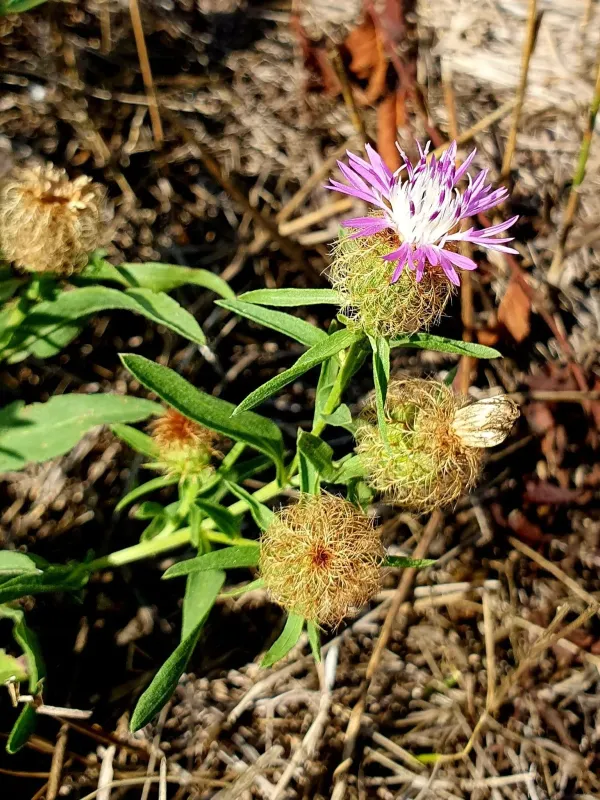
The plant features an erect, branched stem that can grow up to 100 cm in height. The leaves are oblong, often pinnately lobed, and covered with characteristic grayish, spider-web-like pubescence.
The inflorescence is a flower head surrounded by an involucre with hairy appendages. This specific hairiness of the flower head is the primary botanical feature that distinguishes it from other Centaurea species.
The tubular florets are typically purple or bright pink. After flowering, the plant produces achenes equipped with a pappus, facilitating wind dispersal over large distances.
Its root system consists of a deep taproot, which allows the plant to access subsoil moisture, making it highly drought-tolerant and difficult to eradicate by shallow cultivation.
Where it grows
This weed is commonly found in steppe and forest-steppe regions. It thrives in open, dry areas, hillsides, roadside verges, and uncultivated lands where competition is relatively low.
In agricultural settings, Centaurea trichocephala invades winter grain crops, sunflowers, and corn, effectively competing with these crops for sunlight and soil nutrients.
The weed exhibits a wide tolerance for different soil types, including clay and carbonate-rich soils, where it can quickly establish deep-rooted colonies.
Disturbed field edges, fallow land, and fencelines serve as primary reservoirs from which seeds and root fragments spread into active crop fields.
Its resilience allows it to persist even in fields that are subjected to irregular tillage or inadequate crop rotation practices.
Harm it causes
The primary damage caused by this weed is the intense competition for soil water and essential minerals. Its deep taproot dries out soil layers that are vital for crop success.
The plant produces allelopathic compounds that are released into the soil, which can inhibit the germination and early growth of neighboring crop seedlings.
Presence of the weed in harvesting fields significantly degrades the quality of the grain, necessitating expensive post-harvest cleaning and processing to remove weed seeds.
Infection leads to thinning of the crop stand, creating gaps that facilitate further weed encroachment and overall reduction in final yield.
On pastures, the plant is considered a nuisance because its fibrous stems and prickly flower heads reduce the palatability of the forage for livestock.
How to control
Mechanical control through deep plowing is essential, as it helps to sever and expose the taproots to drying, which depletes the plant's energy reserves.
Incorporating competitive crops into the rotation cycle, such as densely seeded cereals, can help shade out the weed and limit its ability to photosynthesize effectively.
Chemical control involving systemic herbicides is necessary for long-term management. Products containing 2,4-D, dicamba, or sulfonylureas are typically employed to reach and kill the root system.
The most effective timing for herbicide application is the rosette stage, ensuring that the active ingredients are translocated deep into the roots for a permanent kill.
- Regular monitoring of field margins and fallow strips.
- Using clean, certified seeds to prevent the introduction of new weed populations.
- Prompt eradication of isolated clusters before they expand into the main field.
Taxonomy
- Latin name
- Centaurea trichocephala
- Family
- Сложноцветные (астровые)
- EPPO code
- CENTC