
Yellow star-thistle
Centaurea sulphurea
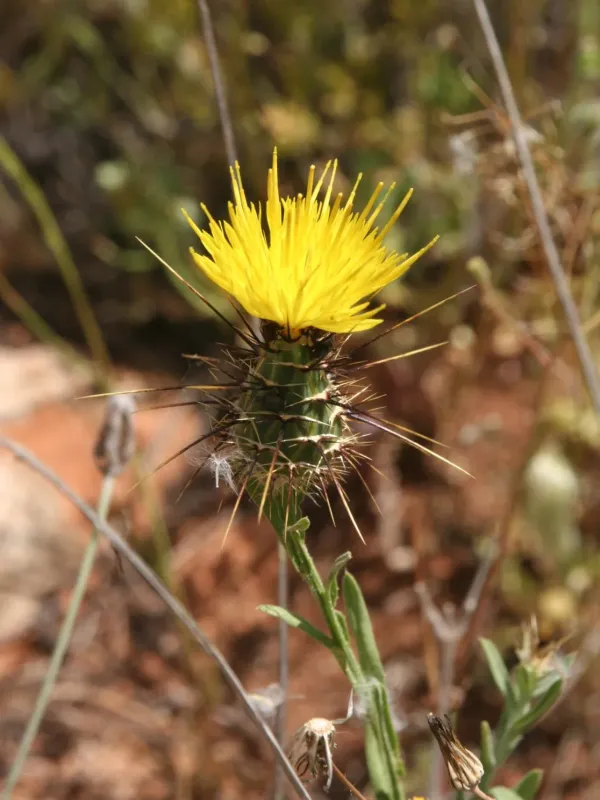
Description
How to tell it apart
Yellow star-thistle (Centaurea sulphurea) is a member of the Asteraceae family. It is an annual plant characterized by a stiff, upright, and branched stem.
The leaves are pinnately lobed and typically covered with fine, woolly hairs, which gives the plant a greyish-green appearance.
The yellow flowers are arranged in small heads, protected by hard, spine-tipped bracts that make the plant easily recognizable during the flowering stage.
It possesses a deep taproot that allows the plant to access moisture in the deeper layers of the soil, providing it with a competitive edge.
The plant spreads solely via seeds, which are equipped with pappus, facilitating long-distance dispersal by wind and agricultural machinery.
Where it grows
This weed is commonly found in grain fields, pastures, and disturbed soil areas such as roadsides, field edges, and abandoned agricultural lands.
It thrives in dry, sunny environments and is well-adapted to the hot, arid climates found in many agricultural production regions worldwide.
The plant is highly adaptable to various soil types but prefers well-drained soils where it can establish its extensive root system without competition.
Invasion often starts from fence lines or neglected non-crop areas, quickly spreading into the main field through mechanical transport or wind.
Frequent soil disturbance without subsequent crop canopy closure creates ideal conditions for the rapid establishment of star-thistle populations.
Harm it causes
Yellow star-thistle is a significant competitor for soil moisture and nutrients, which directly leads to reduced yields in both dryland and irrigated crops.
The spines on the mature heads can be abrasive, potentially causing physical discomfort to workers and livestock when managing infested areas.
Heavy infestations significantly interfere with harvest operations, causing clogging of equipment and increasing the cleaning costs for the harvested crop.
The presence of this weed can lead to a reduction in the nutritive value of hay and forage crops due to its high fiber content and low palatability.
By shading the soil surface and utilizing resources, it suppresses the growth of beneficial crops, leading to significant economic losses for farmers.
How to control
Effective management of yellow star-thistle requires an integrated approach to reduce seed production and eliminate existing populations from the field.
Cultural control methods such as competitive planting, where fast-growing crops are used to shade out the weed, are highly recommended.
Mechanical control involves deep tillage and timely mowing before seed heads mature to prevent further dispersal into the environment.
Chemical control focuses on applying selective herbicides at the rosette stage, which is the most sensitive period for this specific weed.
- Monitor and treat infestations early in the growing season.
- Use clean seed to prevent introduction to new areas.
- Implement proper crop rotation to disrupt the life cycle.
- Utilize pre-emergent and post-emergent herbicides as required.
- Maintain crop vigor to naturally suppress weed growth.
Taxonomy
- Latin name
- Centaurea sulphurea
- Family
- Сложноцветные (астровые)
- EPPO code
- CENSU