
Salonika cornflower
Centaurea salonitana
Description
How to tell it apart
The Salonika cornflower (Centaurea salonitana) is a perennial herbaceous plant belonging to the Asteraceae family. It is recognized as an aggressive root-sprouting weed, capable of spreading through both seeds and an extensive underground horizontal root system.
The plant features an erect stem that grows to a height of 60-100 cm, frequently branching out at the top. Its leaves are alternate, with lower leaves petiolate and upper ones sessile, linear-lanceolate in shape, often covered in grayish pubescence.
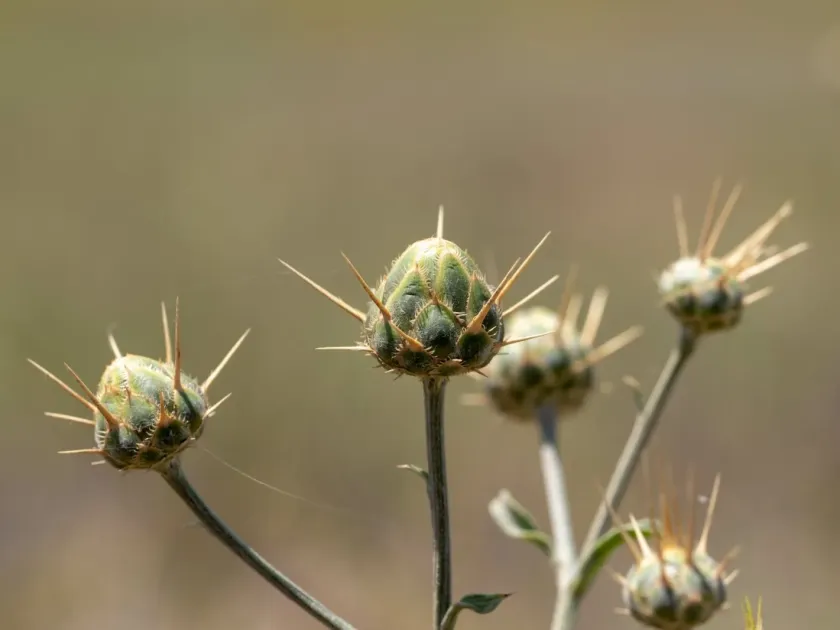
Flowers are arranged in small, dense heads. The involucre of the flower head is characterized by leathery bracts often tipped with spines, which protect the plant and hinder grazing animals.
Reproduction occurs via achenes equipped with pappus, allowing for wind dispersal across large areas. This biological adaptability makes the plant highly effective at colonizing new agricultural territories.
The key identification feature is the deep, persistent root system that allows the plant to overwinter and regenerate rapidly following mechanical soil disturbance.
Where it grows
Salonika cornflower prefers open, arid environments. It is frequently observed in steppes, rocky hillsides, field margins, and along roadsides, showing strong tolerance for poor or calcareous soils.
In agricultural contexts, it poses a significant threat to grain fields, pasturelands, and forage grass production. It is a highly competitive species that thrives in disturbed habitats and can easily invade cultivated land.
Geographically, it is prevalent in regions with moderate continental climates, particularly in the Balkan region and surrounding territories. Its presence in fields is often linked to poor crop rotation practices.
The weed often establishes itself at the edges of fields, from where it gradually encroaches into the interior of cultivated plots, competing with crops for essential resources.
Uncultivated land and fallow fields often act as reservoirs for the weed, facilitating its continuous spread into adjacent productive farmland.
Harm it causes
The primary harm caused by the Salonika cornflower is its intense competition with crops for water, nutrients, and sunlight. Its deep root system depletes soil moisture reserves, which is particularly detrimental during drought periods.
Massive infestation results in reduced crop density and overall yield losses. By suppressing the development of seedlings, the weed significantly compromises the potential harvest of cereals and legumes.
The presence of spiny flower heads in the harvested grain adds complexity to cleaning and drying processes, which lowers the commercial quality of the crop and increases production costs.
On pastures, the plant reduces the nutritional value of forage. Its spiny nature discourages grazing animals, leading to the degradation of meadow quality and productivity.
Additionally, this plant serves as a host for various agricultural pests and pathogens, complicating the overall phytosanitary management and increasing the risk of diseases spreading to commercial crops.
How to control
Effective control of the Salonika cornflower requires a long-term integrated approach that targets both the vegetative and reproductive stages of the plant. Proper crop rotation is the fundamental preventive measure.
Mechanical operations, such as deep autumn plowing, are essential to break up the root network and weaken the plants' ability to resprout. Timely stubble cultivation is also necessary to deplete root energy reserves.
Chemical control focuses on the application of systemic herbicides that are capable of translocating to the root system. Effective options include treatments with 2,4-D, dicamba, or sulfonylurea-based herbicides.
- Systematic mowing before the flowering stage to exhaust root energy reserves.
- Herbicide application during the rosette phase when the plant is most vulnerable to chemical absorption.
- Implementing competitive crop rotations that shade out weed growth.
For non-crop areas, glyphosate-based non-selective herbicides can be utilized. Repeated treatments within the same season are often required to achieve total suppression of an established population.
Taxonomy
- Latin name
- Centaurea salonitana
- Family
- Сложноцветные (астровые)
- EPPO code
- CENSA