
Tyrol knapweed
Centaurea nigrescens
Description
How to tell it apart
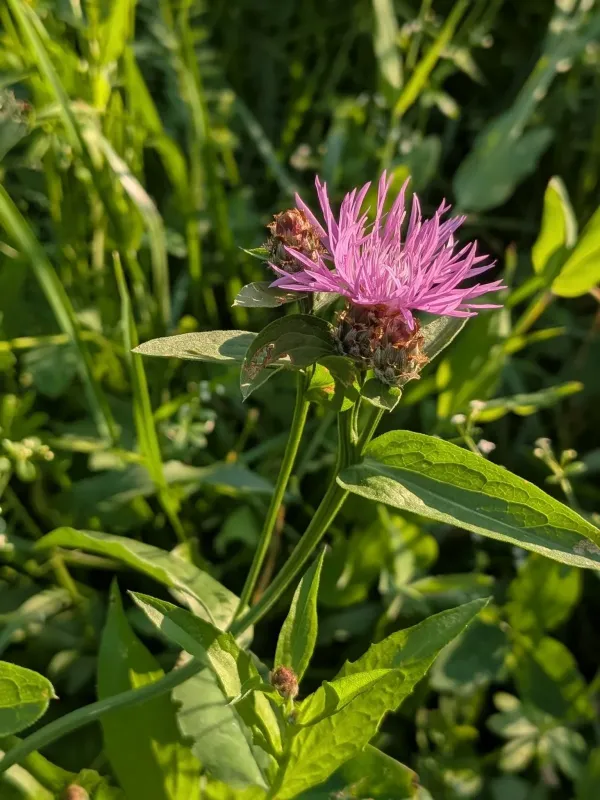
Tyrol knapweed (Centaurea nigrescens) is a perennial herbaceous plant belonging to the Asteraceae family, recognized as a significant weed in various habitats.
The plant features an erect stem that can grow up to one meter high, often branching near the top to support multiple flower heads.
Its leaves are typically lance-shaped, with basal leaves forming a rosette that remains close to the ground, facilitating overwintering.
The most distinctive feature is the flower head, which has dark, almost black, fringed appendages on the involucral bracts, giving the plant its specific appearance.
The flowers are generally purple or deep pink, blooming in mid-summer and producing numerous seeds that can persist in the soil for several years.
Where it grows
Tyrol knapweed prefers moist, fertile soils and is commonly found in meadows, pastures, and along forest edges, from where it spreads into arable land.
It poses a particular threat to perennial grass fields and cereal crops, where it can easily establish itself due to its strong root system.
The plant thrives in environments with sufficient light, often colonizing roadsides and field margins that serve as pathways for dispersal.
Its high adaptability allows it to persist in various soil types, making it a difficult weed to eradicate once it has become established.
The resilience of its root system helps the plant survive agricultural practices, allowing it to regenerate rapidly after mechanical disturbances.
Harm it causes
The primary damage caused by Tyrol knapweed involves intense competition with crops for essential soil nutrients and water, limiting crop growth.
The dense growth habit of the plant shades out neighboring crop seedlings, significantly reducing the overall photosynthetic capacity of the field.
Infestation by this species leads to reduced crop yields and complicates harvesting processes by interfering with standard machinery operation.
In fodder crops, the presence of these weeds decreases the quality of forage because their tough stems are unpalatable to livestock.
Economic losses arise not only from reduced yield but also from the increased cost of grain cleaning and weed management activities.
How to control
Effective control starts with proper crop rotation, which disrupts the life cycle of the weed and prevents its long-term establishment.
Mechanical methods such as deep plowing and regular cultivation are essential for destroying the root systems of the weed before it sets seed.
Chemical control involving selective herbicides is often necessary, especially when targeting the rosette stage of plant development.
- Maintaining clean field borders and pathways.
- Using weed-free certified seeds for planting.
- Timely mowing of non-cropped areas to prevent seeding.
- Applying recommended herbicides in the active growth phase.
- Mechanical weeding of roots in fallow fields.
An integrated weed management strategy, combining mechanical and chemical measures, is the most successful approach to controlling this perennial pest.
Taxonomy
- Latin name
- Centaurea nigrescens
- Family
- Сложноцветные (астровые)
- EPPO code
- CENVO