
Centaurea cineraria
Centaurea cineraria
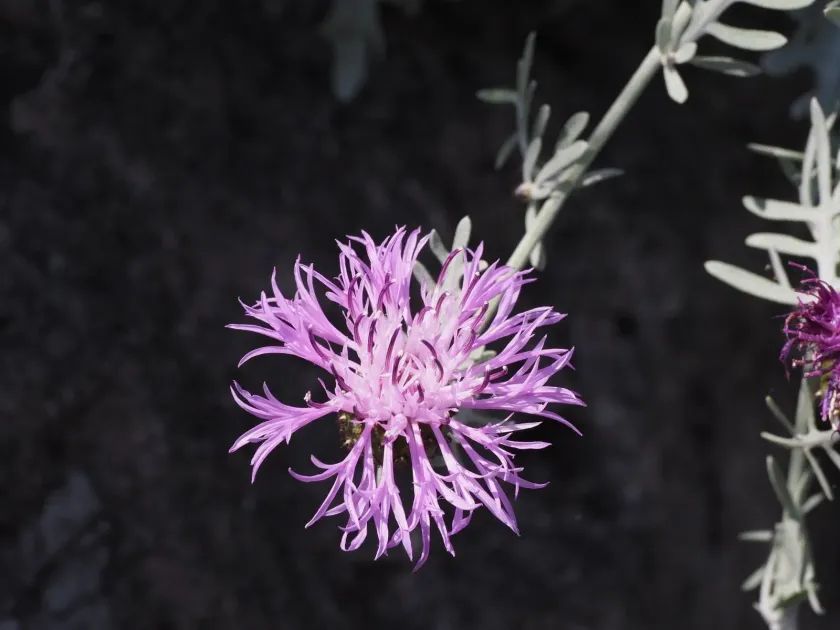
Description
How to tell it apart
Centaurea cineraria, commonly known as dusty miller, is a perennial herbaceous plant belonging to the Asteraceae family. It is characterized by its silvery-grey, woolly foliage, which gives the plant a distinct dusty appearance.
The plant features pinnately lobed leaves arranged in a basal rosette, with upright stems rising up to 60 cm. This woolly pubescence serves as an adaptation to reduce transpiration in dry environments.
Its flower heads are purple or pink and enclosed in bracts with dark-colored, fimbriated edges. These structural features are essential for accurate identification in field conditions.
The root system is robust and taprooted, allowing the plant to reach moisture deep within the soil profile, making it a resilient perennial competitor.
Reproduction occurs primarily through seeds, which are equipped with a pappus that allows for efficient wind dispersal across cultivated landscapes.
Where it grows
This weed species thrives in open, sunny, and dry locations. It is frequently found along roadsides, rocky outcrops, and waste areas where it can establish itself without competition.
In agricultural settings, it commonly infests fallow lands, pastures, and perennial crop fields that have been poorly managed or show reduced plant density.
It prefers well-drained, calcareous soils and generally avoids areas characterized by heavy, waterlogged, or acidic conditions.
Because of its xerophytic nature, it often persists in arid regions where other weeds might struggle due to limited water availability.
The plant acts as a reservoir for infestation, spreading seeds into adjacent productive fields if left uncontrolled during the growing season.
Harm it causes
The primary damage caused by Centaurea cineraria is the competition for vital resources, including soil moisture and nitrogen, which are essential for crop development.
It can significantly reduce sunlight penetration to lower crop levels, hindering photosynthetic efficiency and resulting in lower biomass production.
The presence of this weed in pasture lands is detrimental because its coarse, pubescent foliage is unpalatable to livestock, reducing the nutritional value of forage.
Infestation complicates agricultural operations and increases costs associated with seed cleaning and post-harvest grain processing.
Persistent patches of this weed can lead to a long-term buildup of the soil seed bank, making future eradication increasingly difficult and labor-intensive.
How to control
Effective management begins with deep tillage, which is necessary to disrupt the taproot and prevent the plant from regenerating after mechanical disturbance.
Repeated disking of fallow fields is highly recommended to deplete the energy reserves stored in the roots, eventually leading to the death of the plant.
Chemical control using systemic herbicides, particularly those labeled for perennial broadleaf weeds, is an effective strategy when applied at the rosette stage.
Crop rotation remains a fundamental practice to prevent the accumulation of this perennial weed by disrupting its life cycle through varied cultivation methods.
- Deep plowing to sever the taproot.
- Regular mechanical cultivation during the fallow period.
- Use of systemic selective herbicides.
- Early mowing before seed maturation.
- Maintaining healthy, high-density crop stands.
Taxonomy
- Latin name
- Centaurea cineraria
- Family
- Сложноцветные (астровые)
- EPPO code
- CENCI