
Calycadenia truncata
Calycadenia truncata
Description
How to tell it apart
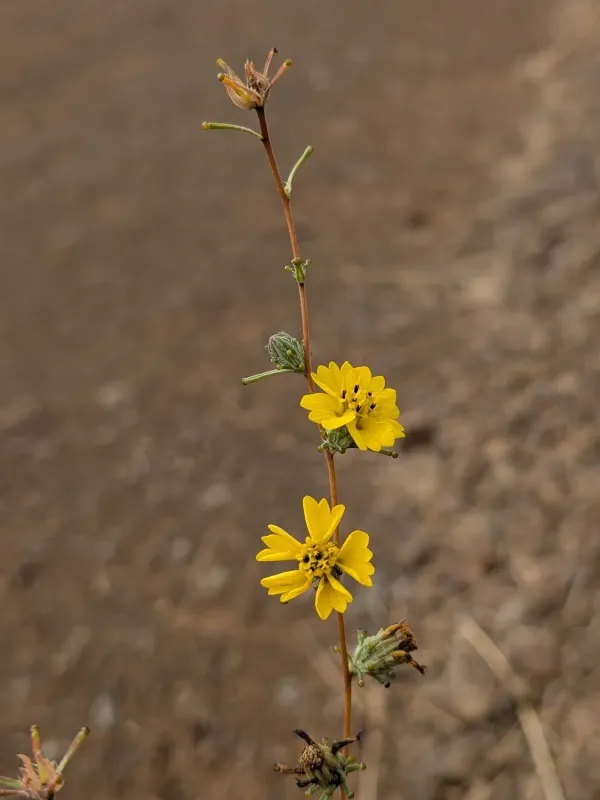
Calycadenia truncata, commonly known as a type of rosinweed, is an annual herb belonging to the Asteraceae family, native to the western regions of North America.
The plant features an erect stem that can reach heights of 60 to 80 centimeters and is characterized by glandular hairs that make the foliage feel sticky.
Its leaves are narrow and linear, arranged alternately along the stem, often exhibiting a scent associated with the volatile oils produced by the plant.
During the flowering season, the plant produces flower heads with yellow or white petals, which are frequently marked with reddish spots at the base.
The fruit is an achene equipped with a pappus, a structure that facilitates long-distance dispersal via wind, allowing the species to spread rapidly across diverse terrains.
Where it grows
In its natural range, Calycadenia truncata is found in dry, open habitats, including hillsides, grasslands, and disturbed soil sites where competition is low.
Within agricultural environments, it poses a threat to dry-land crops, vegetables, and pastures located in Mediterranean-climate regions.
The weed often colonizes field edges, road verges, and irrigation channels, acting as a reservoir for seed spread into cultivated fields during farming operations.
It thrives in well-drained, gravelly, or sandy soils but is capable of establishing itself in heavier soils where cultural practices are inadequate.
The plant demonstrates high resilience to drought conditions, giving it a competitive edge over sensitive crops during periods of low precipitation.
Harm it causes
The primary damage caused by Calycadenia truncata is its intense competition for soil moisture, which directly affects crop yield in arid or semi-arid environments.
Its deep root system allows the plant to access water and nutrients effectively, leaving crops deprived of essential resources needed for proper development.
The dense foliage of the weed can shade out young crop seedlings, significantly delaying their growth and reducing the uniformity of the field stand.
Presence of glandular secretions and specific oils can degrade the quality of harvested forage or hay, potentially affecting livestock consumption.
The prolific production of seeds creates a persistent soil seed bank, necessitating multiple years of intensive management to reduce its population significantly.
How to control
Effective management begins with robust crop rotation, which breaks the lifecycle of the weed by preventing it from setting seed annually.
Mechanical control measures, such as timely plowing and cultivation of inter-row spaces, are highly effective when performed before the onset of the flowering stage.
Chemical control involving selective herbicides can be employed in heavy infestations, provided the product application aligns with the crop's development phase and local regulations.
Cultural practices that promote rapid canopy closure, such as optimal seeding rates and fertilization, help minimize the light available to the weed, thereby suppressing its growth.
Sanitation of field borders and equipment is critical to prevent the introduction of seeds into clean areas, acting as a primary preventive strategy against infestation.
Taxonomy
- Latin name
- Calycadenia truncata
- Family
- Сложноцветные (астровые)
- EPPO code
- KKDTR