
Lanceleaf ragweed
Ambrosia bidentata
Description
How to tell it apart
Lanceleaf ragweed (Ambrosia bidentata) is an annual herbaceous weed belonging to the Asteraceae family, well-known for its competitive nature in agricultural environments.
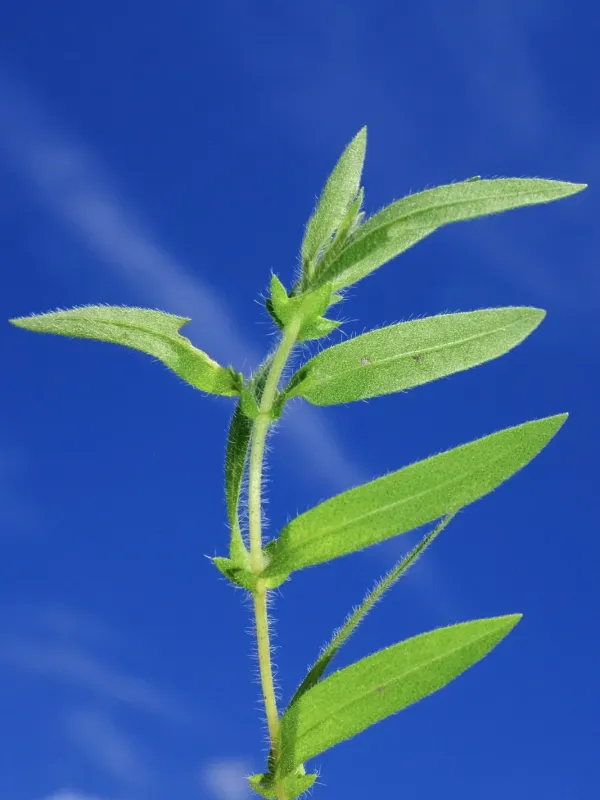
The key morphological characteristic of this species is its simple, lance-shaped leaves with a toothed margin, which are arranged oppositely along the stem.
The plant grows upright, reaching a height of up to one meter, and is covered with rough, stiff hairs that provide a distinct texture to the entire plant body.
It possesses a strong taproot system that allows it to thrive in various soil types, including sandy and poor-nutrient soils, by tapping into deep moisture reserves.
The flowers are unisexual: the male flowers are organized in terminal spikes, while the female flowers are located at the base of the upper leaves, contributing to its prolific seed production.
Where it grows
Native to North America, Lanceleaf ragweed is commonly found in the central and southern regions of the United States, preferring disturbed soils and open fields.
It is a significant pest in row crops, particularly in soybeans, corn, and grain sorghum, where it successfully competes for available resources.
This weed also colonizes roadside verges, pastures, and abandoned lands, taking advantage of lack of vegetation cover to establish large populations.
Ambrosia bidentata exhibits high ecological plasticity, meaning it can adapt to diverse environmental conditions, including compacted soils and various light exposures.
Seed dispersal is facilitated by wind and machinery, allowing the weed to spread rapidly across large agricultural landscapes if not managed proactively.
Harm it causes
The primary economic impact of Lanceleaf ragweed is its aggressive competition with crops for nutrients, sunlight, and soil moisture, which significantly reduces total harvest.
Because of its rapid growth rate, the weed can quickly overtop young crop plants, creating shade that inhibits the photosynthesis of the desired commercial crops.
The plant releases allelopathic substances through its root system, which can inhibit the germination and development of neighboring crops, further stressing the yield.
In addition to agricultural damage, the pollen produced by the weed is a potent allergen that affects workers in the fields during the late summer flowering period.
Contamination of harvested grain with ragweed seeds is a frequent issue, necessitating extra cleaning procedures and reducing the market grade of the product.
How to control
Effective management requires an integrated approach that combines cultural, mechanical, and chemical control methods to minimize the population.
Crop rotation is essential to disrupt the weed's life cycle, along with maintaining high crop competition through optimal planting density and row spacing.
Mechanical control involves timely cultivation or mowing, which must be performed before the plant reaches the flowering stage to prevent seed dispersal.
Chemical control includes the application of pre-emergence and post-emergence herbicides, tailored to the specific crop and the growth stage of the weed.
- Implementing comprehensive field monitoring to detect infestations early.
- Using herbicide programs with different modes of action to manage potential resistance.
- Practicing strict equipment sanitation to prevent the spread of seeds between fields.
- Prioritizing the suppression of weed patches before they expand to the entire crop area.
Taxonomy
- Latin name
- Ambrosia bidentata
- Family
- Сложноцветные (астровые)
- EPPO code
- AMBBI