
Common ragweed
Ambrosia
Description
How to tell it apart
Common ragweed (Ambrosia artemisiifolia) belongs to the Asteraceae family. It is a highly adaptable annual plant characterized by a deep taproot that can reach depths of up to four meters in search of moisture.
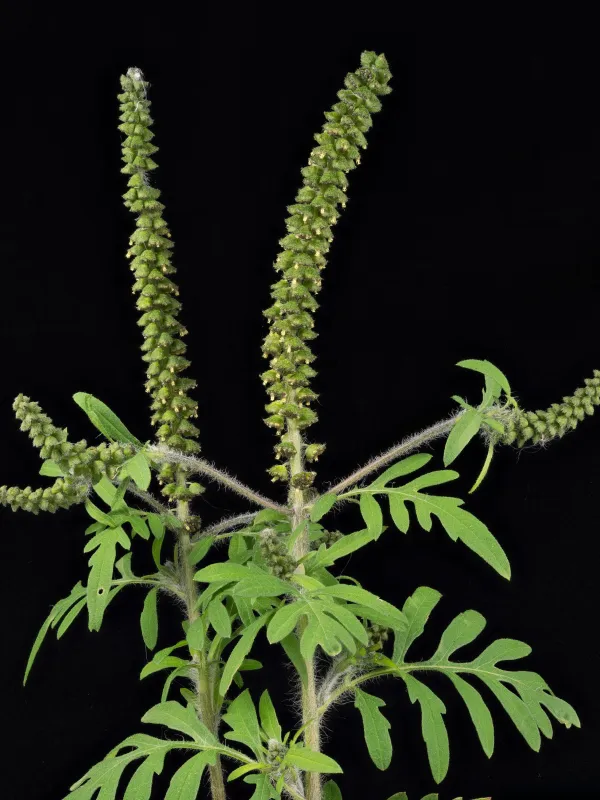
The stem of the plant is erect, branched, and covered in fine hairs, reaching heights between 20 and 150 centimeters. The leaves are deeply pinnately lobed, displaying a dark green color on the upper side and a lighter, grayish-green shade beneath.
Its flowers are small and arranged in spike-like racemes at the tops of the branches. The male flowers are notorious for producing vast quantities of wind-borne pollen, which acts as a potent allergen for humans.
The fruit is a small, hard achene with spines, which allows it to easily attach to machinery, animals, or human clothing. This mechanism significantly contributes to the rapid spread of the species across fields and regions.
The life cycle typically begins when soil temperatures reach 6 to 8 degrees Celsius. Seedlings emerge throughout the spring, while the plant enters its flowering phase during the late summer months of August and September.
Where it grows
Common ragweed is a typical ruderal species, thriving in disturbed soils such as roadsides, construction sites, and waste grounds. It is an opportunistic colonizer that quickly occupies open spaces.
In agricultural settings, it poses a severe threat to row crops like corn, soybeans, and sunflowers. It competes fiercely for nutrients, sunlight, and water, often outgrowing the crop during the early stages of development.
The plant demonstrates high ecological plasticity, allowing it to grow on a variety of soil types ranging from fertile loams to depleted or salty soils, provided there is enough light for its development.
Dispersal is primarily human-mediated. It is frequently introduced to new areas via contaminated seed lots, agricultural machinery that has not been cleaned, or through the movement of soil and forage materials.
As an invasive species, it has expanded its range significantly in recent decades. Climate change and warmer temperatures have allowed it to penetrate higher latitudes where it was previously restricted.
Harm it causes
The primary agricultural impact of ragweed is its high water consumption. A single mature plant can transpire thousands of liters of water, creating significant moisture deficits that lead to stunted crop growth and lower yields.
In sunflower and soybean fields, ragweed can significantly reduce yields by shading the crop canopy and competing for nitrogen and phosphorus. Its presence often necessitates expensive late-season weed management interventions.
Ragweed pollen is one of the most common causes of hay fever. The economic impact includes public health costs, such as medical treatment and loss of productivity, making it a major social and environmental issue.
Contamination of harvested grain with ragweed seeds is a frequent issue in the grain industry. The seeds are difficult to clean out due to their size and shape, leading to downgraded quality and increased processing costs.
When present in hay or forage, the weed can taint the quality of animal feed. Due to its essential oils, it can impart an unpleasant taste to the milk of dairy cows, impacting the economic value of the produce.
How to control
Cultural control strategies include implementing diverse crop rotations. Incorporating small grains or winter crops helps to disrupt the life cycle, as these crops are harvested before the ragweed matures and sheds its seeds.
Mechanical control measures such as deep plowing can bury seeds to depths where they are less likely to germinate. Regular inter-row cultivation is essential to keep the crop canopy clear during the critical weed-free period.
Chemical control involves the use of pre-emergent and post-emergent herbicides. Pre-emergent applications help to manage early germination, while post-emergent herbicides are used for spot-spraying or field-scale weed management.
- Usage of selective herbicides registered for specific row crops.
- Application of glyphosate in fallow fields to manage high-density infestations.
- Maintaining field hygiene by cleaning machinery to prevent seed movement.
Successful management of ragweed requires a multi-year effort focused on depleting the soil seed bank by preventing seed production through consistent mowing, cultivation, or targeted herbicide use.
Taxonomy
- Latin name
- Ambrosia
- Family
- Сложноцветные (астровые)
- EPPO code
- AMBSS