
Ageratum houstonianum
Ageratum houstonianum
Description
How to tell it apart
Ageratum houstonianum, commonly known as flossflower, belongs to the Asteraceae family. Although primarily grown as an ornamental, it is known to behave as an invasive weed in many regions due to its prolific self-seeding capability.
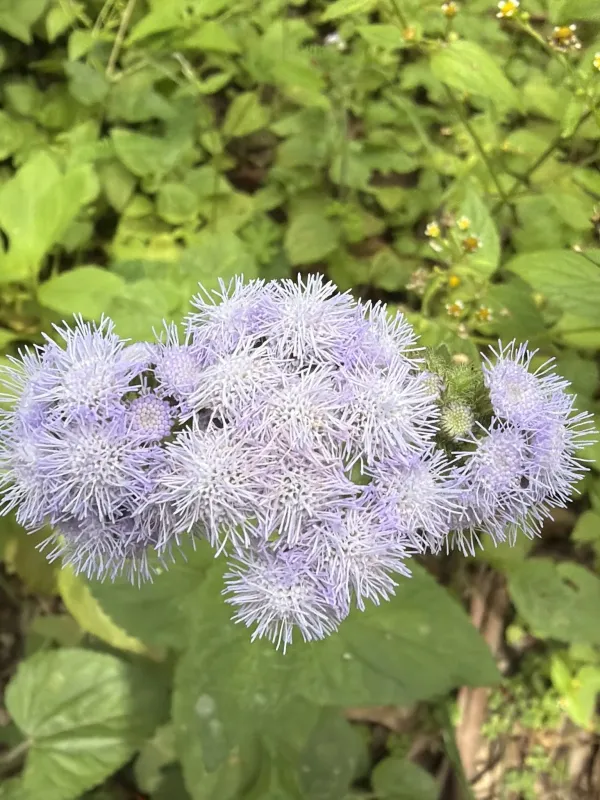
The plant features erect, branched stems covered with fine hairs, typically growing 10 to 60 cm tall. The leaves are opposite, ovate or heart-shaped, with serrated margins, which helps distinguish it from other garden weeds.
Its distinctive flowers are clustered into dense, fluffy-looking heads, usually shades of blue, purple, or white. These flowers are highly attractive to pollinators, ensuring successful seed production.
The fruit is a small achene with a pappus, allowing for easy dispersal by wind. Seeds are highly persistent in the soil, meaning that once the plant has established itself, it can remain a problem for years.
The root system is fibrous and spreads quickly in moist soil conditions, allowing the plant to colonize bare ground rapidly and outcompete native or planted species.
Where it grows
Ageratum houstonianum thrives in sunny locations with well-drained, fertile soil. It is frequently found invading garden beds, parkland, and agricultural margins where it can exploit disturbed soil.
In many temperate climates, it has naturalized in disturbed areas, roadsides, and abandoned fields. It easily establishes itself in gaps left by other vegetation, forming dense, monocultural patches.
It prefers high humidity and moisture, making it particularly troublesome near irrigation channels or in damp, shaded parts of a property where other weeds also flourish.
The plant's ability to propagate via wind-dispersed seeds makes it an efficient colonizer of new territories, often appearing in areas far from the original planting site.
In intensive agricultural settings, it can persist along field edges, acting as a source for re-infestation of the cultivated area if not properly managed during the off-season.
Harm it causes
The main harm caused by Ageratum houstonianum is its rapid displacement of desirable plants. Its aggressive growth pattern allows it to shade out smaller plants, depriving them of necessary light.
It competes aggressively for soil moisture and nutrients, which can lead to stunted growth in adjacent crops or ornamental flowers, reducing their overall vigor and yield.
Ageratum can act as a secondary host for various plant viruses and pests, including whiteflies and spider mites, which can subsequently migrate to crops and cause significant damage.
The plant's massive seed production creates a long-term maintenance challenge, as seedlings will continue to emerge throughout the growing season, requiring frequent labor-intensive removal.
Because it establishes so quickly, it can form thick mats that are difficult to clear, especially in dense planting areas where manual weeding risks damaging the root systems of preferred plants.
How to control
The primary control strategy involves mechanical removal before the plant reaches the flowering stage. Stopping the lifecycle before seeds mature is critical to reducing the soil seed bank.
Deep cultivation or tilling in the autumn can help bury seeds deep enough to prevent germination. Repeating this process over several seasons significantly reduces the population.
Mulching is a highly effective control measure. Using organic or synthetic mulches prevents the light from reaching the soil, which effectively inhibits the germination of Ageratum seeds.
In non-crop areas, post-emergent herbicides can be used for spot treatment. Always ensure that the chosen product is appropriate for the site and follow safety guidelines to protect the surrounding environment.
- Manual weeding before flowering begins.
- Regular soil cultivation in spring.
- Applying thick layers of mulch to garden beds.
- Monitoring potential entry points like drainage ditches.
Taxonomy
- Latin name
- Ageratum houstonianum
- Family
- Сложноцветные (астровые)
- EPPO code
- AGEHO