
Ageratum conyzoides
Ageratum conyzoides
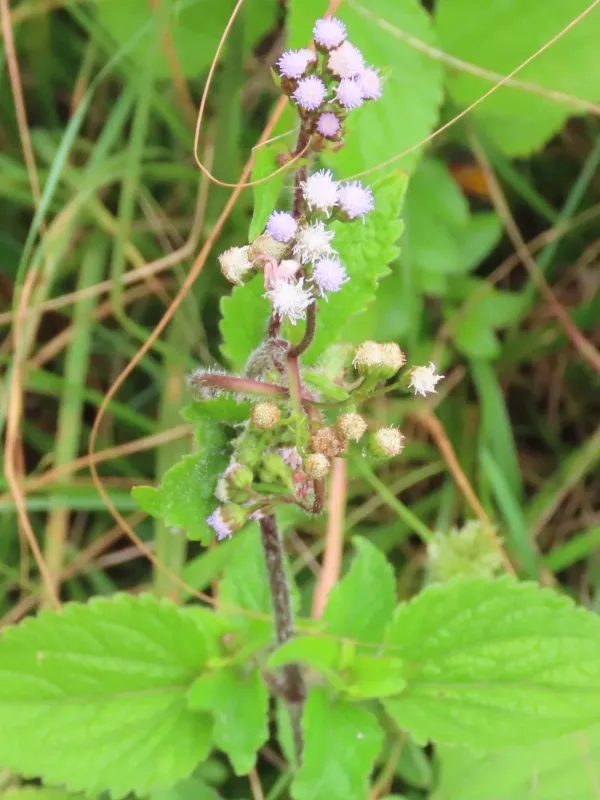
Description
How to tell it apart
Ageratum conyzoides is an annual herbaceous plant belonging to the Asteraceae family. It typically grows to a height of 30 to 80 cm, featuring ovate leaves with serrated margins.
The stems and leaves are covered with fine, white, soft hairs, giving the plant a somewhat velvety appearance. The flowers are arranged in small, dense heads, colored white, blue, or purple.
The root system is fibrous and shallow, which allows the plant to anchor itself firmly in moist, fertile soils. Its rapid growth makes it a highly competitive species in various environments.
Seeds are produced in large quantities and are equipped with a pappus, facilitating wind dispersal. This mechanism allows the weed to colonize new areas quickly after disturbance.
The plant is often identified by its characteristic, somewhat unpleasant odor, which distinguishes it from other common weeds found in similar habitats.
Where it grows
Native to tropical regions, Ageratum conyzoides has become naturalized in many parts of the world, particularly in warmer climates where it thrives in agricultural settings.
It prefers sunny, moist locations and is commonly found in disturbed areas, roadsides, irrigation ditches, and cultivated fields, including plantations of various crops.
The species shows high adaptability to different soil types, ranging from sandy loams to heavier clay soils, as long as moisture levels remain relatively high.
It is a frequent invader in corn, rice, and vegetable plantations, where it competes aggressively for space and light during the critical stages of crop development.
Urban landscapes and abandoned lands are also primary habitats, serving as reservoirs that facilitate the spread of the weed into neighboring agricultural land.
Harm it causes
Ageratum conyzoides is known for its high competitive ability, significantly reducing crop yields by competing for essential nutrients, water, and sunlight.
It exhibits strong allelopathic effects, releasing chemical compounds into the soil that inhibit the germination and growth of neighboring crops, further suppressing development.
The plant serves as a major host for various pathogens and pests, including tobacco leaf curl virus, which can devastatingly impact vegetable and tobacco crops.
The presence of this weed complicates farming operations, increasing the labor and costs associated with weeding and site maintenance throughout the growing season.
Dense infestations can impede mechanical harvesting and reduce the quality of harvested produce due to the contamination of crop seeds with weed seeds.
How to control
Successful management of Ageratum conyzoides requires a combination of preventative measures and targeted control efforts throughout the growth cycle.
Mechanical control, such as timely hoeing and weeding, is highly effective if performed before the plant reaches its flowering stage to prevent seed dispersal.
Chemical control involves the use of systemic and selective herbicides, which are chosen based on the specific crop being protected and the growth stage of the weed.
- Applying pre-emergence herbicides to prevent seed germination in the soil.
- Using post-emergence herbicides for active suppression of established plants.
- Implementing crop rotation to disrupt the life cycle of the weed and minimize soil seed bank accumulation.
Regular monitoring of field margins and fallow areas is essential to prevent re-infestation, as this weed can quickly re-establish itself from seeds stored in the soil.
Taxonomy
- Latin name
- Ageratum conyzoides
- Family
- Сложноцветные (астровые)
- EPPO code
- AGECO