
Sea cudweed
Achillea maritima
Description
How to tell it apart
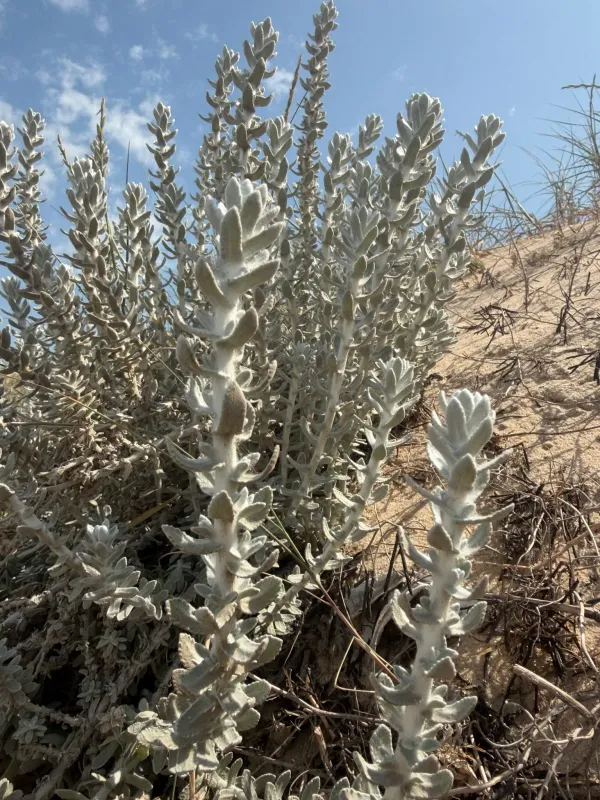
Sea cudweed, scientifically known as Achillea maritima, belongs to the Asteraceae family. It is a perennial herbaceous plant characterized by dense, silvery-white tomentose (woolly) hairs, which provide protection against harsh coastal conditions.
The plant features prostrate or ascending stems that form thick, dense mats on the ground. Its leaves are covered in a heavy layer of felt-like hair, giving the entire plant a distinctive light appearance that helps distinguish it from other field weeds.
Yellow, disc-shaped flower heads appear at the tips of the stems during the summer months. Following the flowering period, the plant produces small achenes, which are easily disseminated by wind and water across large areas.
Its root system is robust and well-adapted to sandy, nutrient-poor environments. These deep roots allow the plant to secure itself firmly in the substrate, ensuring survival in times of severe drought.
Due to its high degree of biological plasticity, the plant can rapidly adapt to various soil compositions, making it a persistent and challenging weed when it invades cultivated agricultural land.
Where it grows
The primary habitat for sea cudweed is coastal dunes and sandy areas near the seashore. It prefers loose, sandy soils that are low in nutrients and may contain a certain level of salinity.
In modern agricultural practice, this weed is frequently found on farmland adjacent to coastal regions. As new land is cleared for cultivation, sea cudweed easily migrates from its natural coastal niche into the fields.
It poses a significant threat to vegetable crops and cereals grown on light, sandy-loam soils. The weed competes efficiently with crops, especially in soils that are not intensively fertilized.
Seed dispersal is facilitated by natural forces such as tidal surges, ocean waves, and wind gusts that carry seeds from maritime areas onto neighboring agricultural plots.
Once established in a field, the plant forms stable patches that are difficult to eradicate. Its perennial nature allows it to persist year after year if environmental conditions remain favorable.
Harm it causes
The primary damage caused by sea cudweed is severe competition with crops for essential water and mineral resources. In sandy soil conditions, this depletion significantly reduces total crop yield.
The weed actively absorbs soil moisture, creating water stress for cultivated plants, particularly during the critical summer growth phase. This results in stunted crop development and reduced market value.
The presence of dense mats of sea cudweed interferes with standard mechanized agricultural operations. These patches can clog cultivation equipment and impede the precision of sowing and weeding machinery.
The plant may act as an alternative host for various pests and diseases that affect commercial crops. This increases the overall pressure on the farm to utilize more pesticides and fungicides.
The economic impact is manifested through both yield loss and increased operational costs. Farmers are forced to invest more in soil remediation and integrated weed management programs to protect their fields.
How to control
Effective management begins with sound agronomic practices. Deep plowing with soil inversion is an essential technique to disrupt the weed's root system and prevent its spread across the field.
Implementing a rigorous crop rotation schedule is vital. By rotating crops with different growth requirements, farmers can disturb the development cycle of sea cudweed and exhaust its nutrient reserves.
Chemical control involving systemic herbicides is often necessary for large-scale infestations. The choice of herbicide must be carefully selected based on crop safety and the specific phenological stage of the weed.
Spot-spraying infected patches during the active growth season is an efficient way to control the weed while minimizing the environmental impact and reducing the overall volume of chemicals used.
A successful control strategy combines mechanical soil preparation with targeted chemical applications. Consistent follow-up on field margins and drainage areas is crucial to prevent re-infestation.
Taxonomy
- Latin name
- Achillea maritima
- Family
- Сложноцветные (астровые)
- EPPO code
- OTAMA