
Balloon cotton bush
Gomphocarpus physocarpus
Description
How to tell it apart
Balloon cotton bush (Gomphocarpus physocarpus) belongs to the Apocynaceae family. It is a perennial shrub that often confuses observers due to its unusual, decorative-looking fruit.
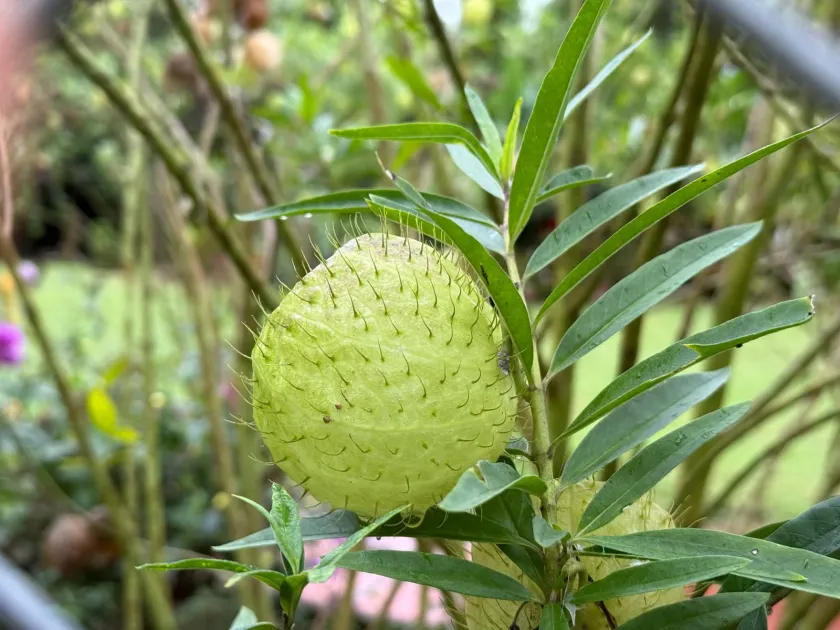
The plant is most easily identified by its distinctive fruit, which are large, inflated, pale green, bladder-like pods covered in soft, hair-like structures. These pods give the plant its common name and aid in seed dispersal.
The leaves are narrow, lance-shaped, and arranged oppositely along the stems. The plant is known for its milky, latex-like sap that oozes from damaged stems or leaves.
Flowers are white or cream-colored, typically arranged in drooping umbels. They are small but visually striking, contributing to the plant's ability to thrive in diverse environmental conditions.
The root system is robust and deep-seated, allowing the plant to remain anchored and resilient even when subjected to mechanical efforts to remove it from the soil.
Where it grows
Native to Southern Africa, the balloon cotton bush has naturalized in many tropical and subtropical regions globally, becoming an invasive nuisance in countries like Australia.
It thrives in disturbed environments, such as roadside verges, waste ground, pastures, and along the banks of watercourses where the soil is sufficiently damp and fertile.
In agricultural settings, it can infiltrate orchards, vineyards, and field crops. It is highly opportunistic and quickly colonizes gaps in vegetation caused by land mismanagement.
The plant prefers full sun and well-drained soils. Its rapid growth rate enables it to outcompete native or crop species for available nutrients and water resources.
Once established in a field, the plant can spread via wind-dispersed seeds, creating dense colonies that are difficult to manage without systematic and sustained efforts.
Harm it causes
The primary concern regarding the balloon cotton bush is its high toxicity. It contains cardiac glycosides that are poisonous to both humans and livestock, especially cattle and sheep.
Grazing animals are at high risk if they consume the plant, as ingestion can lead to severe poisoning. Even in hay, the toxic compounds remain stable, posing a risk to livestock during winter feeding.
The weed acts as a strong competitor for resources in agricultural fields, reducing the total yield and quality of crop production due to its aggressive growth habits.
It can also serve as a host for various insects and pathogens that negatively impact agricultural productivity, making the management of the surrounding crops more complex.
Its prolific seed production ensures that once a population is established, it can easily spread to neighboring fields and pastures, increasing the overall cost of weed control for the farmer.
How to control
Effective management requires a multi-faceted approach, starting with the mechanical removal of young plants before they reach the stage of fruit development to prevent seed spread.
Deep cultivation and soil disturbance can help weaken the root system of larger plants, although this must be coupled with monitoring for regrowth from any remaining root fragments.
Chemical control is often necessary for larger infestations. Systemic herbicides, particularly those based on glyphosate, have proven effective when applied correctly to the foliage of the plant.
For selective control in orchards, targeted application methods are preferred to minimize exposure to non-target crops and maintain the balance of the field ecosystem.
Continuous vigilance and the early detection of the balloon cotton bush are essential for containment, as small outbreaks can be managed relatively easily compared to fully established weed colonies.
Taxonomy
- Latin name
- Gomphocarpus physocarpus
- Family
- Кутровые
- EPPO code
- GOPPH