
Bloodflower
Asclepias curassavica
Description
How to tell it apart
Bloodflower (Asclepias curassavica) is a perennial herbaceous plant belonging to the Apocynaceae family. It is often misidentified as an ornamental species due to its vivid colors.
The stems are erect and sparsely branched, typically reaching a height of 50 to 100 centimeters. Its leaves are arranged in an opposite pattern and are lanceolate in shape with pointed tips.
A key diagnostic feature is the milky latex present in all parts of the plant. This sticky white sap is released immediately upon any injury to the stems or leaves.
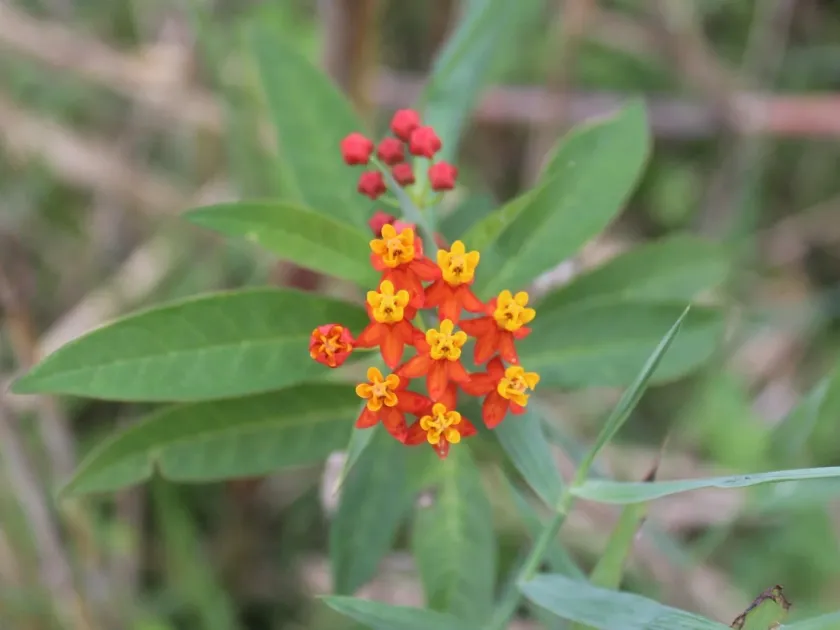
The flowers are arranged in umbellate clusters. The corolla is bright red or orange, often accompanied by a contrasting yellow or orange crown, which makes the plant visually distinctive.
Fruits are fusiform follicles containing numerous seeds. Each seed is attached to a tuft of silky white hairs, which facilitates long-distance wind dispersal across agricultural landscapes.
Where it grows
Bloodflower primarily thrives in tropical and subtropical regions. However, it displays significant invasive behavior in warmer temperate zones and areas with disrupted soil cover.
It is commonly found in abandoned fields, waste areas, roadsides, and along irrigation ditches. The plant easily colonizes disturbed sites where competition from native species is low.
In farming, it poses a threat to row crops, orchards, and pastures. Its ability to tolerate various soil types makes it a persistent weed in many cultivated environments.
The species spreads primarily through wind-borne seeds, allowing it to rapidly infest new areas. Its affinity for moist habitats makes it particularly problematic near water sources.
As a heat-loving plant, it maintains vigorous growth during the summer months, effectively outcompeting many slow-growing crops for essential space and resources.
Harm it causes
The primary concern regarding Bloodflower is its toxicity. It contains cardenolides (cardiac glycosides), which are dangerous if ingested by livestock, leading to severe poisoning.
Livestock consuming contaminated forage may suffer from cardiac arrhythmias, convulsions, and even mortality, posing a significant economic risk to farmers and ranchers.
As an agricultural weed, it competes intensely with crops for water, light, and nutrients. Its deep root system allows it to persist even under moderately dry conditions.
The presence of dense stands of Bloodflower interferes with standard machinery operations. Stems can clog harvesting equipment, leading to downtime and reduced operational efficiency.
Furthermore, it acts as a secondary host for various plant viruses and pathogens, which can be transmitted to crops, negatively affecting the overall yield and product quality.
How to control
Mechanical control involves regular mowing or uprooting. This must be performed before the plants begin to flower to prevent seed production and further spreading across the field.
Deep plowing can help manage young infestations by disrupting the root system. Repeated cultivation is often necessary to exhaust the carbohydrate reserves stored in the plant's roots.
Chemical control utilizing systemic herbicides is the most effective approach for large infestations. Glypohosate-based products applied during the active growth phase show the best results.
Selective herbicides should be utilized within specific crop stands to ensure the weed is eliminated without harming the target agricultural production.
- Monitor fields frequently for early detection of seedlings.
- Ensure manual removal includes the entire root system.
- Implement diverse crop rotations to minimize seed bank accumulation.
- Maintain clean machinery to prevent the transfer of seeds between sites.
Taxonomy
- Latin name
- Asclepias curassavica
- Family
- Кутровые
- EPPO code
- ASCCU