
Narrow-leaf cotton bush
Gomphocarpus fruticosus
Description
How to tell it apart
The Narrow-leaf cotton bush (Gomphocarpus fruticosus) is an evergreen perennial shrub belonging to the Apocynaceae family, reaching up to two meters in height.
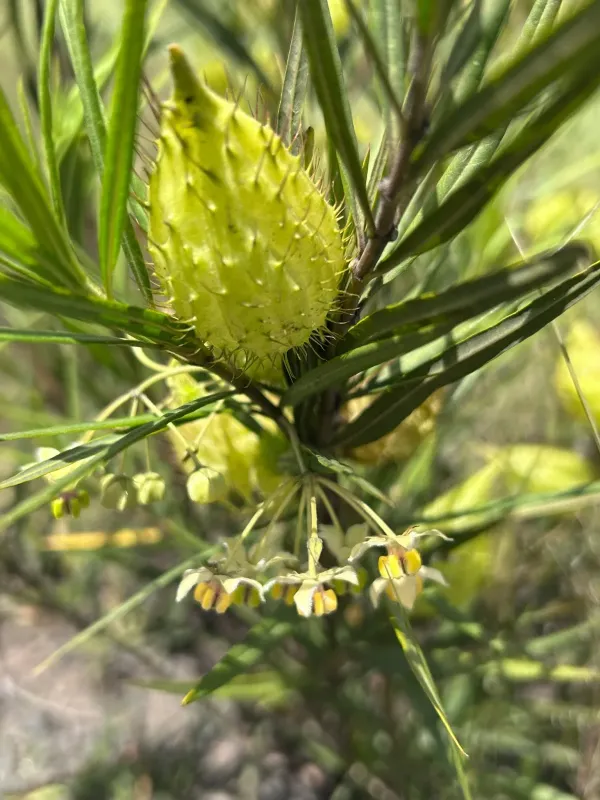
The plant features narrow, lance-shaped, opposite leaves and white to creamy-yellow flowers arranged in drooping, umbel-like clusters.
The most distinctive feature is the fruit, which consists of inflated, egg-shaped pods covered in soft bristles that resemble small, airy balloons.
Each pod contains numerous seeds attached to a tuft of long, silky hairs, enabling efficient wind dispersal over vast distances.
The entire plant is characterized by a milky latex sap, which is a key trait of the family and contains toxic compounds.
Where it grows
Native to Southern Africa, this plant has become a problematic invasive species in various parts of the world, including Australia and the Mediterranean.
It thrives in open, sunny environments, typically colonizing waste ground, roadsides, riverbanks, and disturbed agricultural land.
The species shows a high tolerance for poor, dry soils, allowing it to establish itself in areas where other vegetation struggles to survive.
In agricultural contexts, it often invades pastures and the edges of crop fields, acting as a reservoir for further expansion.
Its ability to quickly adapt to various microclimates makes it a persistent weed that can remain in an area for many years if not managed.
Harm it causes
The primary danger posed by this plant is its toxicity to livestock, as it contains cardiac glycosides that can cause fatal poisoning if ingested.
As an agricultural weed, it competes with desired crops for water, light, and nutrients, thereby reducing total land productivity.
Its invasive nature leads to the displacement of native forage grasses, which decreases the quality and safety of livestock feed.
The presence of this weed complicates mechanical harvesting processes and may require additional labor to clear fields of the toxic stalks.
Furthermore, its rapid seed production and dispersal mechanism allow it to colonize new fields and fence lines with ease, complicating farm management.
How to control
Mechanical removal, such as hand-pulling or digging out the root system, is highly effective for young plants before they establish deep roots.
Regular slashing or mowing should be conducted before flowering to exhaust the plant's nutrient reserves and prevent the spread of seeds.
Chemical control involving the application of systemic herbicides is often necessary for larger infestations to ensure deep root penetration.
Always use protective equipment when handling the plant, as the milky sap can cause severe skin irritation and is dangerous to the eyes.
Integrated management, including crop rotation and the establishment of vigorous competitive ground cover, is essential for long-term suppression.
Taxonomy
- Latin name
- Gomphocarpus fruticosus
- Family
- Кутровые
- EPPO code
- GOPFR