
Honeyvine milkweed
Cynanchum laeve
Description
How to tell it apart
Honeyvine milkweed (Cynanchum laeve) is a perennial vine belonging to the Apocynaceae family. It is a vigorous climber that can grow several meters in length, easily overtopping crops and vegetation.
The leaves are opposite, heart-shaped with smooth, entire margins and a pointed tip. The foliage is glabrous, meaning it lacks the hairs commonly found on other milkweed species.
White to cream-colored flowers are arranged in small, umbel-like clusters. They bloom in mid-summer, attracting various pollinators, which facilitates the production of numerous seeds.
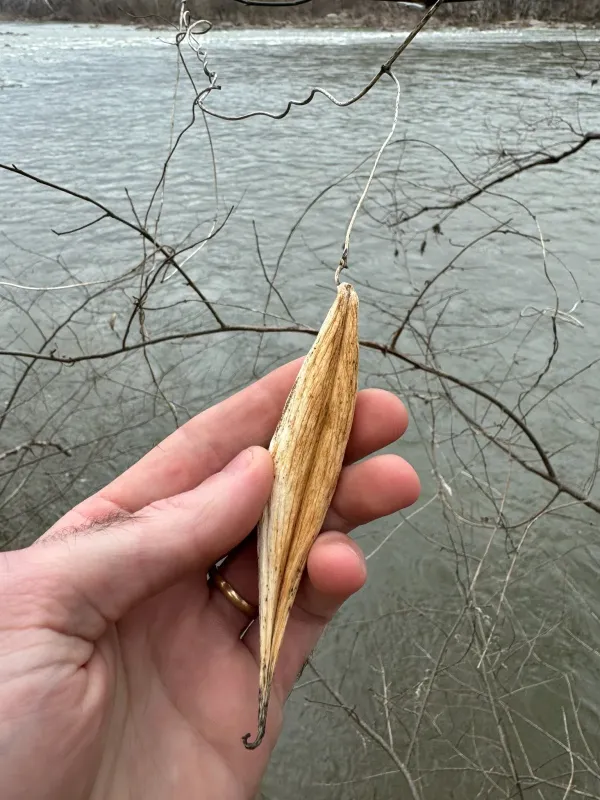
The fruit consists of elongated pods that split open upon maturity. Each seed possesses a tuft of silky hairs, or coma, allowing for efficient wind dispersal over vast agricultural areas.
A deep taproot system, combined with horizontal rhizomes, allows this plant to persist in the soil for years. Even small fragments of root left after cultivation can sprout and form new plants.
Where it grows
This species thrives in full sun and fertile soils. It is commonly found in waste areas, along fence rows, roadsides, and the edges of agricultural fields where it can find support structures.
In farming, it is a significant nuisance in row crops like soybeans, corn, and orchards. It exploits reduced-tillage systems where root systems are not disturbed frequently.
The weed rapidly invades undisturbed areas, creating dense mats that can smother low-lying vegetation. It is highly adaptable to various soil types, provided there is adequate moisture.
Because it is a climber, it uses standing crops as trellises. This ability allows it to move from field edges into the interior of cultivated plots quite efficiently.
Widespread distribution is aided by the lightweight seeds carried by wind, making it a persistent problem for both organic and conventional farm management.
Harm it causes
The primary economic impact is the competition for nutrients, water, and sunlight. By shading the crop canopy, it reduces the overall photosynthesis rate and yield potential.
As a climbing vine, it causes lodging in grain crops, making harvesting difficult. The heavy mass of vines can entangle machinery, leading to increased downtime and maintenance costs.
It competes aggressively for soil moisture, which is often the limiting factor in crop production during the summer months. This reduces the vigor of the target crop.
The plant acts as a reservoir for certain insects and pathogens that can spread to cultivated crops, complicating integrated pest management strategies.
Control is challenging because the plant is a perennial; it stores energy in its roots throughout the season, allowing it to recover from partial injury or mechanical mowing.
How to control
Integrated management is essential for controlling this weed. Mechanical cultivation, such as deep plowing, can help disrupt the root system, although it must be repeated over several years to be effective.
Chemical control with systemic herbicides is most effective when applied during the active growing stage, as the chemical is translocated down into the extensive root system.
In soybean and corn production, post-emergence selective herbicides are used to suppress growth. However, multiple applications are often required due to the plant's robust nature.
Preventative measures include cleaning equipment to avoid spreading root fragments and maintaining a competitive crop canopy to shade out the seedlings early in the season.
- Use systemic herbicides like glyphosate for non-crop areas.
- Perform deep mechanical tillage in late autumn.
- Maintain dense crop cover to suppress light-dependent seedlings.
- Spot-treat patches before seed set to prevent wind dispersal.
Taxonomy
- Latin name
- Cynanchum laeve
- Family
- Кутровые
- EPPO code
- AMPAL