
Calotropis procera
Calotropis procera
Description
How to tell it apart
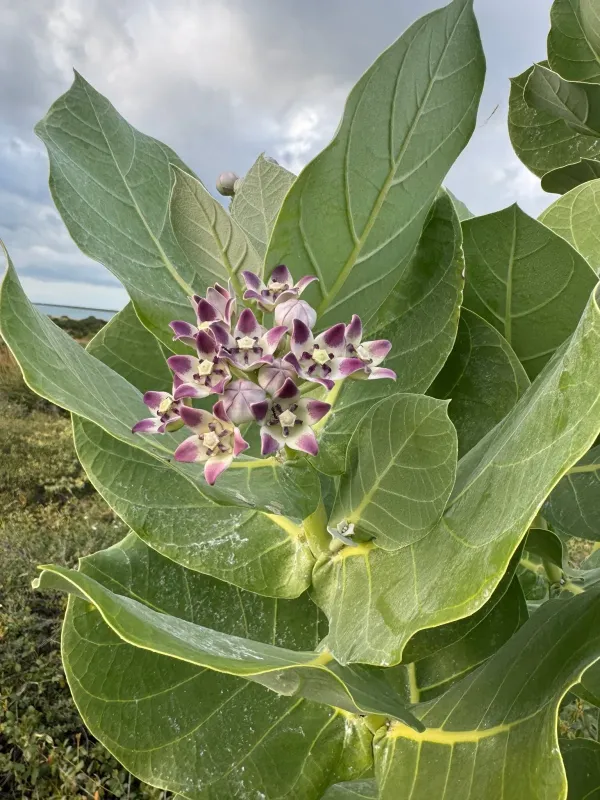
Calotropis procera, commonly known as apple of Sodom, is a woody perennial shrub belonging to the Apocynaceae family, characterized by its drought-tolerant nature.
The plant grows up to 3–4 meters in height and features large, opposite, thick, and waxy leaves that serve to minimize water loss in arid environments.
It is easily identifiable by its clusters of purple and white flowers and large, inflated, green fruits that split to release seeds attached to tufts of silky hair.
The stems and leaves contain a viscous, milky white latex which is highly toxic to livestock, humans, and some insects, acting as a defense mechanism.
Its root system is exceptionally deep and strong, allowing the plant to survive in poor, rocky, and sandy soils where other crops struggle to establish.
Where it grows
This weed is widely distributed throughout the arid and semi-arid regions of Africa, the Middle East, and South Asia, thriving in harsh sunlight and low rainfall.
Calotropis procera frequently invades abandoned agricultural fields, overgrazed rangelands, roadsides, and riverbanks, where it can quickly establish dense, impenetrable stands.
The plant demonstrates high salinity tolerance, enabling it to colonize degraded soils that have been abandoned by farmers due to salt accumulation or lack of irrigation.
Wind-dispersed seeds allow the species to spread rapidly across vast landscapes, making it a challenging invasive plant for local ecosystems and agricultural areas.
It prefers disturbed sites, meaning that poor land management practices often facilitate its colonization and subsequent spread into neighboring productive fields.
Harm it causes
The primary agricultural impact of Calotropis procera is its intense competition with crops for limited water and soil nutrients, leading to significant yield reduction.
It acts as a poisonous weed in pastures; the presence of toxic glycosides in the leaves causes severe health complications or death if ingested by livestock.
Through the release of allelopathic compounds, the plant inhibits the germination and growth of neighboring beneficial species, creating monocultures of the weed.
Large woody stems create physical barriers in fields, disrupting the efficient use of agricultural machinery such as tractors, seeders, and harvesters.
Additionally, it serves as an alternative host for various pests and pathogens that can eventually migrate to nearby high-value cash crops, complicating pest control.
How to control
Mechanical control is effective for isolated or young plants; however, the entire taproot must be removed to prevent the shrub from re-sprouting during the rainy season.
Chemical intervention involving systemic herbicides applied to cut stumps or active foliage is often necessary for managing larger, established infestations.
Regular deep plowing is a recommended agrotechnical method to physically damage the root system and disturb the growth cycle of the weed in large-scale fields.
Prevention is critical; land managers should implement early detection and rapid response protocols to eliminate individual plants before they reach the seeding stage.
Integrating chemical control with pasture rotation or controlled land use can help mitigate the weed's competitive advantage in grazing or cultivated areas.
Taxonomy
- Latin name
- Calotropis procera
- Family
- Кутровые
- EPPO code
- CTRPR