
Giant Calotropis
Calotropis gigantea
Description
How to tell it apart
Giant Calotropis (Calotropis gigantea) is a perennial, evergreen shrub belonging to the Apocynaceae family, known for its significant size and robust growth habit.
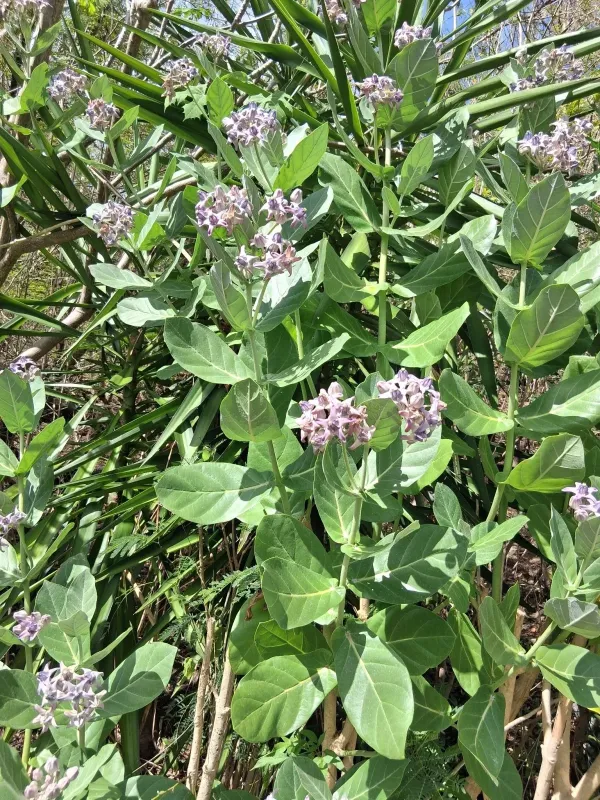
It typically reaches heights of 2 to 4 meters, featuring thick, woody stems and branches that are coated with a fine, waxy, white pubescence.
The leaves are broad, ovate, and arranged in opposite pairs, with a grayish-green appearance caused by the dense covering of small, white hairs.
The flowers are distinctively shaped with five petals and a prominent central crown, usually occurring in clusters with colors ranging from white to deep lavender.
One of the most identifying features is the milky white latex exuded from all parts of the plant when injured, which is highly toxic to many herbivores.
Where it grows
This species is well-adapted to tropical and subtropical climates and is commonly found in disturbed sites, such as abandoned fields, grazing pastures, and roadsides.
It thrives in poor-quality, saline, and arid soils, allowing it to colonize degraded agricultural lands where other vegetation struggles to survive.
In cultivated landscapes, it frequently invades perennial orchards, coconut plantations, and irrigation networks, where it competes aggressively for water and nutrients.
Giant Calotropis prefers open, sunny environments and often forms dense, impenetrable thickets that are difficult to manage with standard agricultural equipment.
Due to its high adaptability and rapid seed dispersal, it is considered a significant invasive species in various regions, often disrupting local agricultural systems.
Harm it causes
The primary agricultural harm stems from its allelopathic properties, as the plant releases chemicals that suppress the growth of nearby crops and beneficial soil organisms.
The milky latex contains cardiac glycosides, making the plant highly poisonous to livestock; ingestion can lead to severe poisoning or even death of grazing animals.
Dense thickets of Giant Calotropis hinder field operations, reduce the efficiency of irrigation systems, and impede the movement of machinery in affected areas.
It acts as a host for various insects and plant pathogens, providing a reservoir that facilitates the spread of diseases to sensitive horticultural crops.
Its ability to quickly dominate land reduces available forage for livestock and significantly lowers the overall productivity of agricultural and pastoral land.
How to control
Mechanical control is effective but labor-intensive, requiring complete removal of the root system to prevent resprouting from surviving underground fragments.
Regular cutting and slashing can weaken the plant over time, but this approach must be combined with other methods to prevent recovery from the established root network.
Chemical control involving systemic herbicides applied to freshly cut stems or foliage has proven effective in managing large, established infestations.
Integrated management is essential, focusing on long-term prevention through the elimination of seed sources and consistent monitoring of agricultural perimeters.
- Deep plowing to destroy young seedlings and expose root systems.
- Targeted herbicide application using systemic products during the active growing season.
- Preventative measures such as maintaining soil cover to restrict germination.
- Coordinated regional management to stop seed dispersal through wind.
Taxonomy
- Latin name
- Calotropis gigantea
- Family
- Кутровые
- EPPO code
- CTRGI