
Whorled milkweed
Asclepias verticillata
Description
How to tell it apart
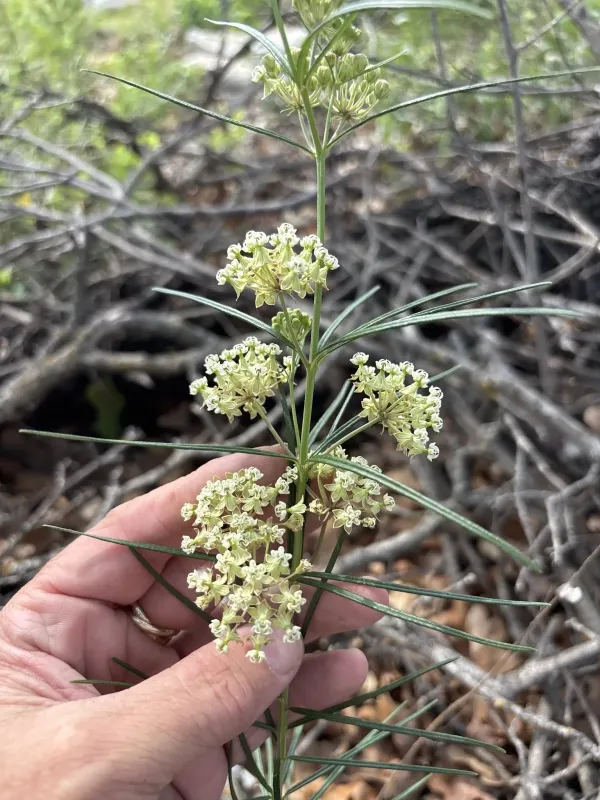
Whorled milkweed (Asclepias verticillata) is a perennial herbaceous plant belonging to the Apocynaceae family. It is recognized by its distinct whorled arrangement of narrow, linear leaves around the stem.
The plant typically reaches a height of 30–90 cm. Like other members of the genus, it contains a milky white latex that is released when the stem or leaves are damaged.
Its small, white-to-greenish flowers are clustered in umbels, blooming throughout the summer months. The visual appearance is slender and delicate, hiding its aggressive nature.
The seeds are attached to silky hairs, which facilitate wind dispersal over long distances. This adaptation makes the plant highly effective at colonizing new areas.
Below ground, the plant maintains a complex system of deep, spreading rhizomes, which are responsible for its resilience and ability to survive harsh environmental conditions.
Where it grows
Whorled milkweed is widely distributed across North America, thriving in open, sunny environments. It is commonly found in prairies, pastures, and along roadsides.
In agricultural settings, it frequently infests field edges and areas with minimal soil disturbance, where it establishes stable, long-term colonies.
The weed is highly adaptable to various soil types, preferring well-drained locations where it can outcompete native or crop-related vegetation for space.
Due to its deep root system, it can colonize areas that are difficult to cultivate, effectively surviving standard agricultural practices.
It often spreads into productive fields from adjacent non-cultivated land, making it a persistent challenge for farmers in the region.
Harm it causes
The primary concern regarding Whorled milkweed is its toxicity to livestock. The plant contains cardiac glycosides that can cause severe poisoning if consumed by cattle, sheep, or horses.
As a weed in agricultural fields, it competes aggressively with crops for water, nutrients, and sunlight, directly impacting total yield.
Its robust rhizomatous structure allows it to deplete soil moisture and nutrients more efficiently than many shallow-rooted annual weeds.
Presence of this plant in forage fields compromises the quality of hay and pasture, creating significant safety risks for animal husbandry.
The difficulty of complete eradication means that an infestation can persist for many years, necessitating consistent and costly management strategies.
How to control
Controlling Whorled milkweed requires integrated management strategies that focus on exhausting the plant's underground energy reserves over multiple seasons.
Chemical control using systemic herbicides is most effective when applied to actively growing foliage before the plant reaches the flowering stage.
- Deep tillage to disrupt rhizome networks.
- Regular mowing to prevent seed production and spread.
- Application of systemic translocated herbicides.
- Crop rotation that includes dense canopy crops to shade out weeds.
- Preventative monitoring of field boundaries and non-crop areas.
Consistent manual or mechanical removal of young shoots can help manage smaller patches, provided it is performed repeatedly over the entire growing season.
Effective management also requires careful coordination with neighboring land managers to prevent the migration of seeds from infested adjacent properties.
Taxonomy
- Latin name
- Asclepias verticillata
- Family
- Кутровые
- EPPO code
- ASCVE