
White milkweed
Asclepias variegata
Description
How to tell it apart
White milkweed (Asclepias variegata) belongs to the Apocynaceae family. It is a perennial herbaceous plant that develops from a strong rhizome, ensuring high survival rates.
The stem is upright, usually solitary, reaching 30 to 100 cm in height. The leaves are opposite, elliptical in shape, smooth, and feature prominent veins.
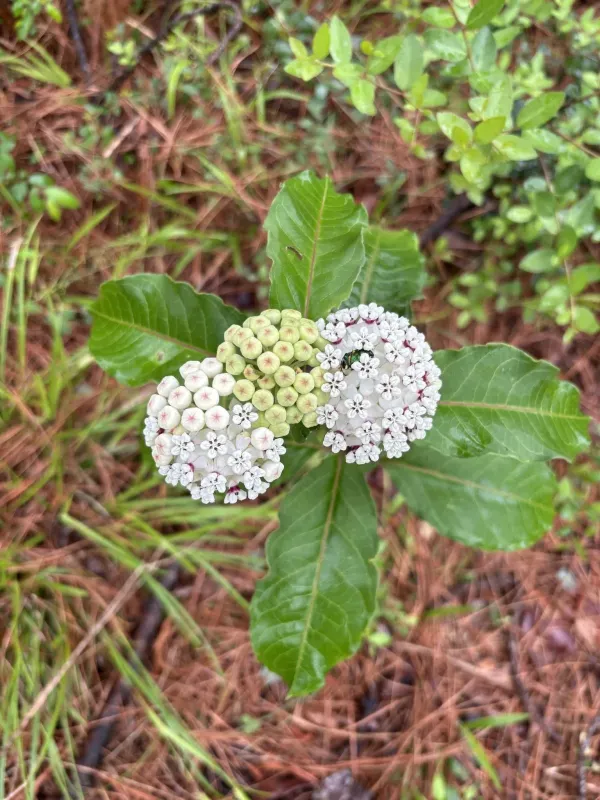
The inflorescences are dense umbels composed of small white flowers with purple bases, making the plant easily recognizable during the flowering period from May to July.
The fruits are elongated follicles filled with numerous seeds equipped with long silky hairs, which facilitate seed dispersal over long distances.
The plant contains a milky sap with toxic alkaloids, which makes it unpalatable for most livestock and resistant to insect damage.
Where it grows
In natural conditions, white milkweed is found in open forest areas, clearings, dry prairies, and abandoned agricultural land, preferring well-drained soils.
As a weed, it is most dangerous in pastures, hayfields, and perennial crop areas, where minimal tillage allows its root system to become deeply established.
The plant quickly colonizes disturbed ground, roadsides, and field edges, from where seeds are dispersed by wind into grain and industrial crop fields.
Disturbance of the soil surface or lack of systematic control leads to the rapid expansion of milkweed colonies, which crowd out useful vegetation.
The species' adaptability allows it to successfully compete for sunlight and nutrients even in poor, well-aerated soils.
Harm it causes
The primary damage caused by white milkweed is high competition with crops for space, moisture, and mineral nutrients.
The presence of toxic substances in the weed's tissues poses a serious threat to livestock; if ingested in hay, it retains its toxicity and can cause poisoning in cattle.
The plant's powerful root system depletes the soil and hinders the normal development of crop root systems, reducing overall field productivity.
Weed infestation makes mechanical harvesting difficult, increases equipment wear, and requires additional costs to clean grain yields.
Due to its perennial nature and ability to reproduce vegetatively, white milkweed is difficult to eradicate, increasing the costs of agricultural practices.
How to control
Effective control of white milkweed requires a complex approach combining deep mechanical soil cultivation and the use of chemical plant protection products.
Agrotechnical methods include regular plowing and cultivation aimed at exhausting the root system and preventing flowering, which stops new seed formation.
For chemical control, systemic non-selective herbicides based on glyphosate or selective preparations targeting perennial dicotyledonous weeds are most effective.
- Early spring herbicide application on actively growing rosettes.
- Follow-up treatment during the budding phase to ensure maximum penetration of active ingredients into the roots.
- Crop rotation including crops that suppress perennial weed growth.
- Manual removal of individual plants before they spread across the field.
It is important to remember that control must be systematic over several seasons, as dormant buds on the rhizome can produce new shoots even after chemical treatment.
Taxonomy
- Latin name
- Asclepias variegata
- Family
- Кутровые
- EPPO code
- ASCVA