
Sullivant's milkweed
Asclepias sullivantii
Description
How to tell it apart
Sullivant's milkweed (Asclepias sullivantii) is a perennial rhizomatous herbaceous plant belonging to the Apocynaceae family, known for its extensive root system.
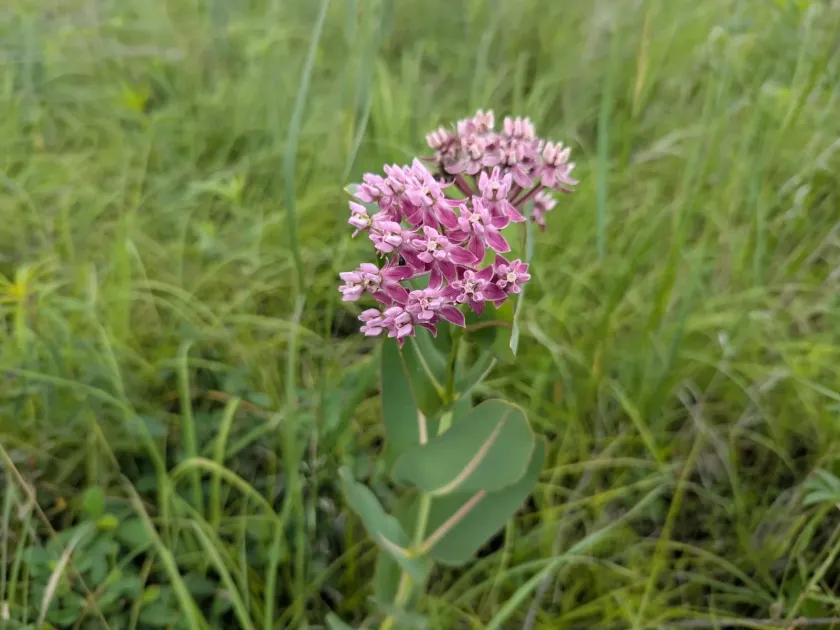
The plant typically grows to about 1 meter in height, featuring stout, smooth stems that do not branch until they reach the inflorescence level.
Leaves are opposite, oblong-lanceolate, and glabrous, often showing a slightly glaucous or waxy texture which is key for botanical identification.
Flowers are arranged in terminal umbels and display a vibrant pink-to-purple color, serving as a primary source of nectar for various pollinators.
The fruit consists of erect, spindle-shaped follicles that split open upon maturity to release seeds equipped with white coma for wind dispersal.
Where it grows
This species naturally thrives in wet prairies and meadows but has successfully colonized anthropogenically disturbed areas like roadsides and agricultural edges.
In farming regions, it frequently invades corn and soybean fields, where it exploits open spaces between crop rows to establish its perennial root network.
The plant is highly resilient and drought-tolerant, allowing it to compete effectively in various soil types, ranging from sandy loams to heavier clays.
It prefers areas with high sunlight exposure, making it a prolific invader in non-shaded, intensively managed agricultural lands.
Once established, the root system spreads horizontally, allowing the plant to create dense, long-lasting patches that are difficult to eradicate with simple tillage.
Harm it causes
Sullivant's milkweed acts as a direct competitor for essential resources such as water, soil nutrients, and light, directly limiting the biomass accumulation of cash crops.
The presence of cardenolides in its milky sap makes the foliage toxic to livestock, creating significant risks if the weed is harvested along with hay or silage.
Its robust stems and extensive root biomass can interfere with harvesting equipment, causing downtime and reducing the overall efficiency of field operations.
The weed serves as a host for various insects and pathogens that can potentially vector diseases to primary crops, complicating integrated pest management.
In high-density infestations, the sheer biomass of the weed can shade out emerging crop seedlings, leading to uneven stands and significant yield loss.
How to control
Cultural control strategies focus on rigorous mechanical cultivation, including deep plowing and frequent discing to fragment and exhaust the energy reserves of the rootstock.
Crop rotation with competitive, early-season cover crops can help shade out young milkweed shoots, effectively suppressing their growth during the critical early development stages.
Chemical control remains the most reliable method for large infestations, utilizing systemic herbicides applied during the plant's active growth stage before flowering.
- Applying glyphosate-based herbicides during the post-harvest period for maximum translocation to roots.
- Using growth-regulator herbicides that effectively target perennial broadleaf weeds.
- Adding non-ionic surfactants to spray solutions to overcome the waxy cuticle of the leaves.
Long-term success requires a combined approach, integrating herbicide applications with sustainable soil management practices to prevent re-establishment from the seed bank.
Taxonomy
- Latin name
- Asclepias sullivantii
- Family
- Кутровые
- EPPO code
- ASCSL