
Whorled milkweed
Asclepias subverticillata
Description
How to tell it apart
Whorled milkweed (Asclepias subverticillata) is a perennial herbaceous plant belonging to the Apocynaceae family. It is characterized by a deep, aggressive rhizome system that allows the plant to persist in the soil for many years despite various disturbances.
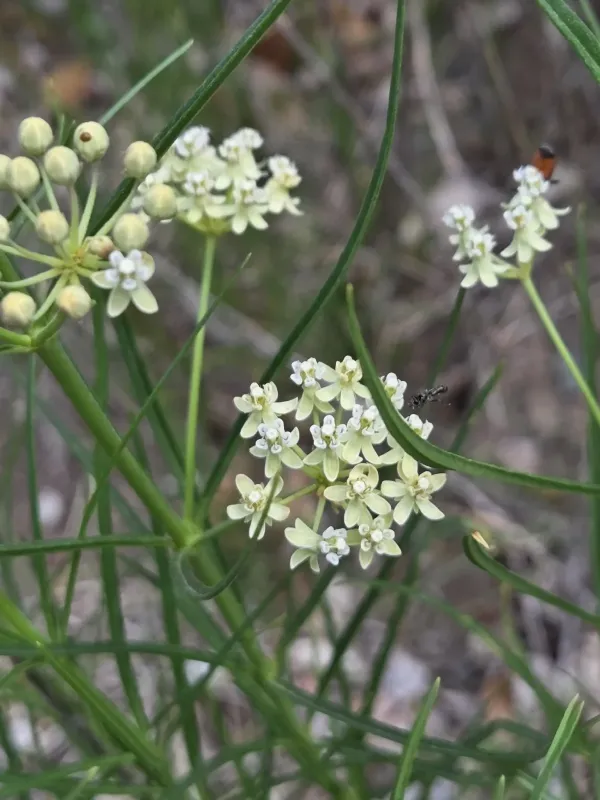
The stems are erect, typically growing to a height of 30–60 cm. The plant's most identifying feature is its narrow, thread-like leaves that grow in distinct whorls around the stem, which is the origin of its common name.
The flowers are small, white to greenish-white, and arranged in umbel-like clusters. After flowering, the plant produces slender, spindle-shaped follicles (pods) filled with seeds that have tufts of hair, facilitating wind-driven dispersal.
Like other members of the milkweed family, all parts of the plant contain a milky, toxic latex. This sap contains cardiac glycosides, which are harmful to many animals and act as a natural defense mechanism against herbivores.
The plant reproduces both through seed dispersal and vegetative propagation via its underground rhizomes. This dual reproduction strategy makes it highly successful at colonizing disturbed agricultural environments.
Where it grows
Whorled milkweed is native to North America, typically found in dry prairies, fields, and along roadsides. In modern agriculture, it has become an invasive concern in various crop fields, especially those under reduced-tillage regimes.
It thrives in well-drained soils, ranging from sandy to clay-heavy, and is highly adaptable to varied environmental conditions. Its ability to tolerate low-moisture environments makes it a persistent weed in arid and semi-arid cropping regions.
The plant often spreads into fields from adjacent pastures, fencerows, or unmanaged buffer strips. Once established, it can expand its territory rapidly due to its ability to sprout from small segments of broken rhizomes.
Agricultural practices such as shallow cultivation or no-till farming may inadvertently encourage its growth by preventing the disruption of its deep-seated root systems. This has increased its presence in corn, wheat, and soybean fields.
The weed is frequently found in competition with native grasses and commercial crops, where it exploits available light and nutrients. Its resilience to many standard cultural practices makes it a significant management challenge.
Harm it causes
The primary concern regarding Whorled milkweed is its toxicity to livestock. Cattle, sheep, and horses that ingest the plant, whether fresh or dried in hay, may suffer from severe cardiac toxicity, which can be fatal even in small quantities.
In terms of crop production, the plant is a vigorous competitor. Its extensive root system allows it to compete for moisture and soil nutrients, often leading to noticeable yield reductions in the affected areas of the field.
The plant can serve as an alternative host for various crop viruses and insect pests. This increases the overall disease pressure within a field, potentially necessitating increased chemical intervention to protect the primary crop.
Mechanical harvesting is also impacted by the presence of Whorled milkweed. The tough, fibrous stems of the plant can clog combine headers and threshing mechanisms, leading to equipment downtime and increased operational costs.
Furthermore, the presence of this weed in pastures significantly reduces the grazing capacity of the land. Because livestock tend to avoid it, the weed effectively displaces desirable forage plants, leading to economic losses for producers.
How to control
Chemical control is generally the most effective way to manage Whorled milkweed infestations. Systemic herbicides, particularly those targeting perennial broadleaf weeds, applied during the active growth stage are recommended.
Cultural control practices, such as deep tillage, can help manage the weed by depleting its energy reserves, although this method is less effective in fields using minimum-tillage or no-till systems. Persistence is key to any control strategy.
Integrated weed management should focus on preventing seed set. Mowing before the flowering stage can help, but since the plant propagates via rhizomes, this alone will not eradicate the infestation.
- Application of systemic herbicides during the pre-flowering stage.
- Crop rotation with vigorous annuals that shade out the weed.
- Maintaining healthy, dense pastures to prevent colonization.
- Rigorous equipment cleaning to prevent the transport of seed and rhizome fragments.
Long-term control requires a multi-year effort. Because the rhizomes can store nutrients for several seasons, consistent monitoring and repeated chemical or mechanical applications are necessary to achieve successful suppression of the weed population.
Taxonomy
- Latin name
- Asclepias subverticillata
- Family
- Кутровые
- EPPO code
- ASCSU