
Rush milkweed
Asclepias subulata
Description
How to tell it apart
Rush milkweed (Asclepias subulata) is a perennial herbaceous plant belonging to the Apocynaceae family. It is characterized by its distinct, slender, and almost leafless stems, which gives it a rush-like appearance, hence the common name.
The stems are green to grey-green and covered in a waxy coating, which is a vital adaptation to conserve moisture in its native arid desert environments. The plant typically grows as a small shrub, often reaching heights of over one meter.
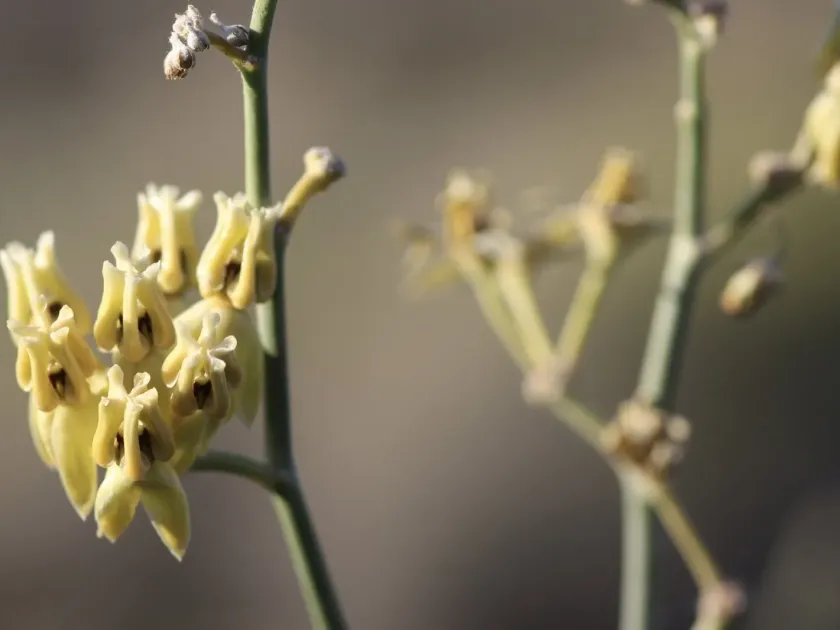
During the blooming season, the plant produces clusters of creamy-white, fragrant flowers in umbels at the tips of the stems. These flowers follow the characteristic structure of the Asclepias genus, featuring complex appendages.
The fruit of the plant consists of smooth, spindle-shaped pods (follicles). When ripe, these pods split open to release seeds attached to tufts of silky hair, which allows the seeds to be easily dispersed by the wind.
A notable botanical feature is the presence of a milky white latex within the stems. This sap is known to be toxic to many animals due to the presence of cardiac glycosides, serving as a primary defense mechanism for the plant.
Where it grows
Rush milkweed is native to the arid regions of the southwestern United States and northwestern Mexico. It is a common feature in desert ecosystems, such as the Sonoran and Mojave deserts, where it favors sandy or rocky soils.
In agricultural settings, this weed primarily invades irrigated lands adjacent to desert areas. It is frequently found colonizing the edges of fields, irrigation ditches, and areas with disturbed topsoil where moisture is available.
Because the seeds are highly adapted for wind dispersal, they can easily travel long distances, establishing new colonies in fields that offer favorable growing conditions and regular water supply.
It prefers well-drained, porous soils but is robust enough to survive in various substrates. The plant's high ecological plasticity allows it to persist even when standard agricultural management is present, especially in neglected field margins.
As a drought-tolerant species, it is particularly successful in areas where irrigation may be inconsistent, as its deep root system allows it to access groundwater that is otherwise unavailable to typical crops.
Harm it causes
The primary agricultural impact of Rush milkweed is its intense competition for limited resources. Its deep taproot system efficiently extracts water and nutrients from the soil, directly threatening the productivity of surrounding crops.
The toxic nature of the plant poses a significant risk to livestock. If accidentally harvested along with forage or hay, the cardiac glycosides can cause severe poisoning or death in cattle and other animals, rendering the feed hazardous.
Invasion of irrigation systems is another critical issue. The plant can clog channels and ditches, obstructing water flow and resulting in inefficient distribution of water to crops, which leads to localized yield losses.
Dense infestations create physical barriers that hinder the use of agricultural machinery, leading to increased wear and tear and higher operational costs for field preparation, maintenance, and harvesting.
Furthermore, the plant's ability to spread via both wind-dispersed seeds and vegetative regrowth from deep roots makes it a persistent weed that can quickly dominate field margins and encroach into the crop rows.
How to control
Mechanical control is often ineffective against Rush milkweed. Simple tilling or disking frequently results in the fragmentation of the root system, which can stimulate rapid regrowth and lead to an even denser population of the weed.
Effective management requires a multi-faceted approach, combining strategic mechanical removal with targeted chemical control. Long-term depletion of the root system's energy reserves is essential for successful eradication.
Chemical control is best achieved using systemic herbicides, particularly those containing glyphosate. Due to the thick waxy cuticle on the stems, the addition of a high-quality surfactant (adjuvant) is necessary to ensure the herbicide penetrates the plant tissue effectively.
Timing is crucial: the most effective application occurs during the period of active growth before seed pods reach maturity. This allows the herbicide to be translocated down to the roots, maximizing the impact on the plant's regenerative tissues.
- Use of systemic herbicides with appropriate surfactants.
- Hand-pulling in early stages of infestation.
- Regular maintenance and weeding of irrigation canals.
- Adopting crop rotation and competitive crop varieties.
- Monitoring and spot-treating field margins to prevent spread.
Taxonomy
- Latin name
- Asclepias subulata
- Family
- Кутровые
- EPPO code
- ASCSB