
Longleaf milkweed
Asclepias longifolia
Description
How to tell it apart
Longleaf milkweed (Asclepias longifolia) is a perennial herbaceous plant belonging to the Apocynaceae family. It is characterized by its long, linear to lanceolate leaves arranged in an opposite or whorled pattern along the stem.
The stems are typically erect, reaching heights of 30 to 80 centimeters. Like many other members of the genus, the plant exudes a milky latex when injured, which is a key diagnostic feature for field identification.
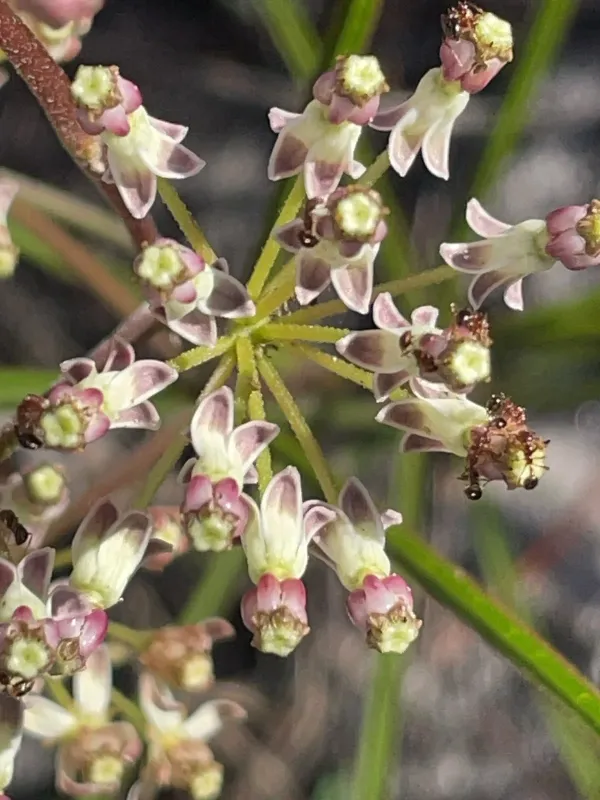
Flowers of the species are arranged in umbellate clusters that emerge from the upper leaf axils. The blossoms are generally greenish-white or creamy, distinguishing them from the more vividly colored milkweed varieties.
The plant possesses a deep, robust root system. This complex rhizomatous structure allows the plant to survive adverse conditions and serves as a significant storage organ for energy.
The fruit of the plant is a follicle that splits open at maturity to release seeds equipped with silky tufts of hair, facilitating wide dispersal via wind currents across agricultural landscapes.
Where it grows
The natural habitat of Longleaf milkweed primarily includes moist prairies, open grasslands, and floodplains. It thrives in soils that provide consistent moisture during the growing season.
In agricultural settings, it is frequently found along field margins, drainage ditches, and in fallow land. It tends to colonize areas where the native soil structure has been disturbed.
The species exhibits high ecological plasticity, allowing it to adapt to varying levels of sunlight. However, it shows a clear preference for moist, nutrient-rich environments that support rapid growth.
It is often seen along road sides and near field edges, where the lack of intensive cultivation allows its rhizomes to spread horizontally and create dense colonies over time.
While not always a primary crop weed, its presence in low-lying areas of fields can lead to significant localized infestation if left unchecked for multiple seasons.
Harm it causes
Longleaf milkweed acts as a strong competitor for soil moisture and nutrients, negatively impacting the development of primary agricultural crops planted in adjacent areas.
The plant is known to contain cardenolides, which make it toxic to livestock. When present in hay fields or pastures, it poses a direct health risk to grazing animals.
Its ability to form dense clusters creates significant physical obstructions for agricultural machinery. This increases the complexity of harvesting and soil preparation processes.
Due to its efficient reproductive strategies, including both seed dispersal and rhizome expansion, it can quickly reduce the yield potential of affected land if management practices are neglected.
Infestation by this species requires higher inputs for chemical maintenance, leading to increased operational costs and reduced profitability for the land manager.
How to control
Effective management of Longleaf milkweed requires an integrated approach that focuses on both the aerial parts of the plant and its deep-seated root systems.
The use of systemic herbicides applied during the plant's active vegetative growth phase is essential for reaching and killing the rhizomes, preventing regrowth in subsequent years.
Mechanical control measures, such as deep tillage or frequent cultivation, can help disrupt the root network, although this must be done consistently to avoid further spreading of fragments.
- Implementing crop rotation to disrupt the plant's growth cycle.
- Applying selective herbicides during the pre-flowering stage.
- Removing isolated plants manually before they set seeds.
Proactive monitoring and the maintenance of dense, healthy crop stands are crucial strategies for preventing the establishment and spread of this weed species across larger areas.
Taxonomy
- Latin name
- Asclepias longifolia
- Family
- Кутровые
- EPPO code
- ASCLO