
Broadleaf milkweed
Asclepias latifolia
Description
How to tell it apart
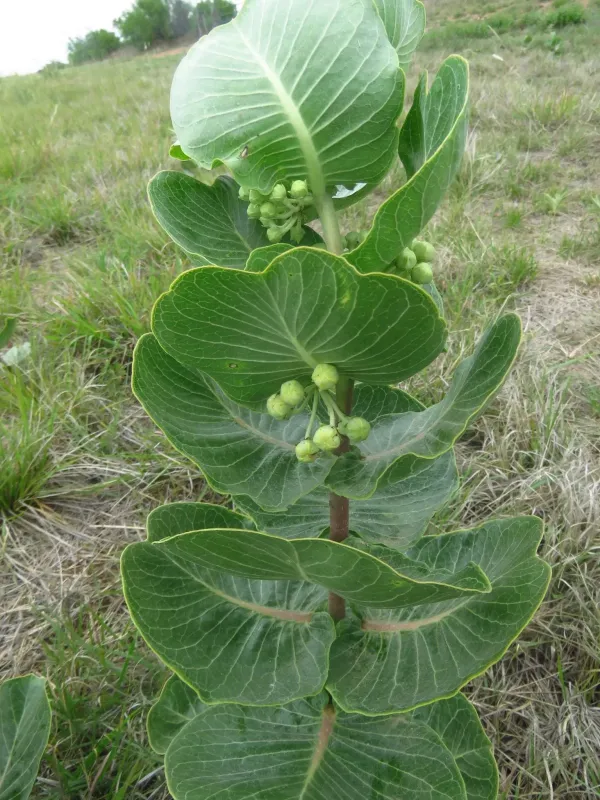
Broadleaf milkweed (Asclepias latifolia) belongs to the Apocynaceae family. It is a perennial herbaceous plant characterized by robust, upright stems that reach heights of 60 to 90 cm.
The leaves are large, thick, and nearly orbicular or broadly ovate in shape, covered with dense hairs that give them a greyish-green appearance. They are arranged in opposite pairs along the stem.
Flowers are gathered in characteristic umbel-like clusters, displaying greenish-white to pale cream tones. The flowering period typically occurs in mid-summer.
Milkweed possesses a well-developed root system, including a deep taproot that allows the plant to successfully withstand periods of severe drought.
When any part of the plant is injured, it exudes a thick, white milky latex containing cardiac glycosides, which makes it highly toxic to livestock and wildlife.
Where it grows
This species is native to the western parts of North America. It prefers open, well-lit habitats with dry, rocky, or sandy soils.
It is most commonly found in pastures, along roadsides, and on abandoned agricultural lands where it can form dense, aggressive colonies.
In cultivated fields, Broadleaf milkweed becomes a serious issue during land reclamation or when crop rotation practices are neglected.
The plant demonstrates high ecological plasticity, enabling it to rapidly colonize areas with low crop density or disturbed soil conditions.
Its spread is often facilitated by wind-dispersed seeds, which possess small hair tufts, making it difficult to localize and contain infestations.
Harm it causes
The primary concern regarding Broadleaf milkweed is its high toxicity to livestock, particularly sheep and cattle, making it a dangerous weed in grazing areas.
In crop fields, it acts as a persistent weed that competes for essential nutrients and moisture, significantly suppressing the growth of agricultural crops.
Its massive root system makes it extremely difficult to eradicate using mechanical methods, as even small root fragments can regenerate into new shoots.
The presence of toxic latex containing alkaloids poses risks not only to animals but can also contaminate harvested grain if green plant parts are mixed in.
Heavy infestations reduce the overall productivity of forage lands and require substantial investment to restore the natural balance of the field.
How to control
Controlling Broadleaf milkweed requires a comprehensive, multi-year approach that combines mechanical and chemical management strategies for long-term suppression.
Mechanical control involves deep plowing and regular cutting of the root system, which helps to exhaust the energy reserves stored in the plant's taproots.
For chemical control, the use of systemic herbicides, such as glyphosate or growth regulator formulations, is recommended during the active flowering stage.
- Frequent mowing before seed set to prevent further spread across the field.
- Implementing crop rotations that include dense, fast-growing cover crops.
- Spot-treatment with selective herbicides in areas of high infestation.
Consistent monitoring of treated areas is essential, as the deep root system often results in secondary regrowth that requires follow-up maintenance sessions.
Taxonomy
- Latin name
- Asclepias latifolia
- Family
- Кутровые
- EPPO code
- ASCLT