
Narrow-leaf milkweed
Asclepias fascicularis
Description
How to tell it apart
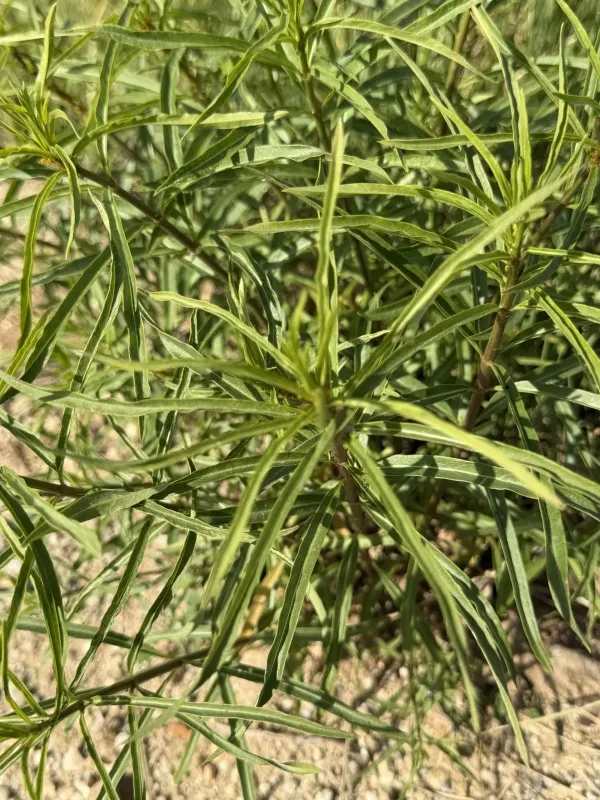
Narrow-leaf milkweed (Asclepias fascicularis) is a perennial plant belonging to the Apocynaceae family, typically reaching heights of 50 to 90 centimeters.
The stems are erect and often branched at the top, characterized by narrow, linear leaves that are whorled or clustered along the stem, giving the plant its distinct appearance.
The flowers are small and arranged in umbel-like clusters, ranging in color from white to pale pink, which attracts various pollinators but belies the plant's aggressive nature as a weed.
Upon maturity, the plant produces slender seed pods that release seeds equipped with silky tufts, allowing them to be easily dispersed by wind over vast agricultural areas.
Like many members of the milkweed genus, this plant contains a toxic milky latex, which acts as a chemical defense mechanism, making it unpalatable and potentially harmful to livestock.
Where it grows
This species is native to the arid and temperate regions of western North America, where it thrives in open, sunny environments with well-drained, often sandy or rocky soils.
Narrow-leaf milkweed is frequently found along roadsides, in neglected fields, on abandoned land, and in degraded pastures, where it establishes itself as a persistent colonizer.
In agricultural settings, it becomes a significant nuisance in hayfields and perennial pastures, where it exploits vacant soil niches to spread via its extensive rhizomatous root system.
Its high level of environmental plasticity allows it to adapt to diverse soil conditions, making it difficult to eradicate from farming environments once it has established a foothold.
It prefers areas with little competition, but once it forms dense clusters, it can effectively shade out native or desired forage species, altering the local plant composition.
Harm it causes
The primary concern regarding narrow-leaf milkweed is its toxicity; it contains cardenolides that are poisonous to livestock, especially if consumed in large quantities in pastures.
It poses a significant threat to hay quality, as the presence of the weed in cut forage renders the hay potentially dangerous for feeding cattle, sheep, or horses.
The weed acts as a strong competitor for nutrients and soil moisture, which stunts the development of cultivated crops and significantly reduces overall agricultural yield.
The dense root network of the plant makes it an incredibly resilient weed that persists year after year, requiring constant management to prevent it from overwhelming entire fields.
Furthermore, its aggressive colonization leads to land degradation, as it outcompetes beneficial vegetation, leading to a loss of pasture productivity and increased management costs for the producer.
How to control
Mechanical control, such as deep tillage, can be effective in disrupting the root system, but repeated operations are usually necessary to exhaust the plant's food reserves.
Chemical control involving systemic herbicides is widely considered the most effective method for eradicating established patches, particularly when applied during the active growth phase.
Management should focus on preventing seed set by mowing the plants before they reach the flowering stage, although this does not eliminate the perennial rootstock.
Integrating chemical applications with rotational grazing and the establishment of vigorous competing crops can help minimize the impact of the weed on pasture productivity.
- Regular mowing prior to flowering to stop seed dispersal.
- Targeted application of systemic herbicides (e.g., glyphosate-based) in spring or early summer.
- Monitoring field borders to prevent encroachment from road verges and uncultivated areas.
- Deep cultivation in early stages to weaken established rhizomes.
Taxonomy
- Latin name
- Asclepias fascicularis
- Family
- Кутровые
- EPPO code
- ASCFA