
Woollypod milkweed
Asclepias eriocarpa
Description
How to tell it apart
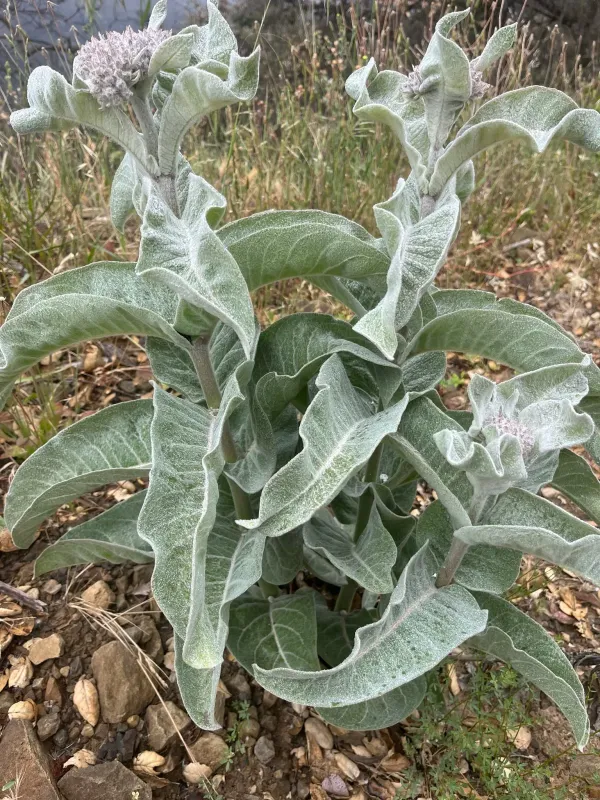
Woollypod milkweed (Asclepias eriocarpa) is a perennial herbaceous plant belonging to the Apocynaceae family, easily recognized by the dense, woolly hairs covering its foliage.
The plant typically grows to a height of 0.5 to 1 meter, with stems that are erect and sturdy. The leaves are arranged oppositely and have a lanceolate shape, covered in thick, white, wool-like trichomes.
It produces impressive umbel-shaped inflorescences consisting of numerous small flowers ranging in color from white to creamy pink. Flowering usually occurs during the summer months.
The fruit of the plant is a distinct follicle, which is also densely pubescent. As it matures, the follicle splits open to reveal seeds equipped with tufts of hair.
These tufted seeds are wind-dispersed, allowing the plant to spread effectively across open landscapes, agricultural margins, and disturbed soil sites.
Where it grows
This species is native to western North America, specifically common in California. It thrives in dry, sunny environments, including mountain slopes, dry valleys, and wasteland areas.
In agricultural settings, it is often found on the borders of fields, along roadsides, and in unmanaged pastures. It is highly drought-tolerant and can persist in poor or rocky soil conditions.
Because of its deep-rooted nature, it can dominate sites where moisture is limited, creating competitive pressure against more desirable vegetation.
It is capable of re-sprouting from rhizomes if damaged, making it a persistent nuisance in areas where mechanical clearing is attempted without complete root removal.
The ability of the plant to adapt to various disturbance levels makes it a frequent inhabitant of neglected agricultural land, from where it can spread into active fields.
Harm it causes
The primary concern regarding woollypod milkweed is its high toxicity. The plant contains cardenolides, which are cardiac glycosides that are poisonous to many animals, including sheep, cattle, and horses.
Ingestion of the plant material causes severe poisoning symptoms, including gastrointestinal distress, rapid heart rate, weakness, and, in many cases, death of the livestock.
Even when incorporated into dried hay, the plant remains toxic, posing a risk to livestock during winter feeding if the hay source was contaminated.
Beyond its toxicity, the plant acts as a weed, competing with pasture grasses for space, sunlight, and soil nutrients, thereby reducing the carrying capacity of grazing land.
For farmers, the presence of this plant necessitates expensive control measures and creates risks of significant economic loss due to livestock mortality.
How to control
Controlling woollypod milkweed requires persistence due to the plant's robust root system, which allows it to recover quickly from superficial mechanical damage.
Integrated management is essential. Manual removal must include the extraction of the entire root system, as residual rhizome pieces can generate new shoots throughout the season.
Chemical control involving systemic herbicides is often the most effective method, particularly when applied during the early growth stage, before the plant allocates too much energy to seed production.
Consistent monitoring and spot treatment are recommended to prevent the weed from establishing dense colonies that are much harder to eradicate once mature.
- Mechanical removal of the entire root ball.
- Application of systemic herbicides during the active growing season.
- Proper pasture management to prevent overgrazing and soil disturbance.
- Regular scouting of pasture borders to eliminate new infestations early.
Taxonomy
- Latin name
- Asclepias eriocarpa
- Family
- Кутровые
- EPPO code
- ASCER