
White-stem milkweed
Asclepias albicans
Description
How to tell it apart
White-stem milkweed (Asclepias albicans) is a perennial succulent shrub belonging to the Apocynaceae family, native to arid environments.
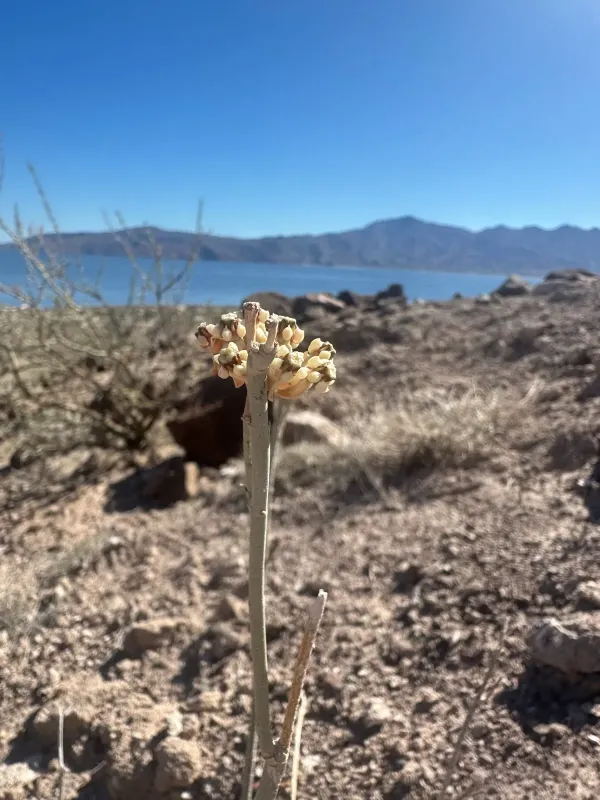
The plant is characterized by its smooth, grey-white stems that give it a distinctive appearance, often appearing almost leafless during the dry season.
It can reach heights of up to 2 meters, developing a robust structural frame that makes it highly resilient to wind and mechanical stress.
The flowers are arranged in umbrella-like clusters and typically exhibit a creamy white color, which is typical for the genus Asclepias.
Each fruit is a long pod that splits open to release numerous seeds, each equipped with a tuft of white hair for efficient wind dispersal.
Where it grows
This species is primarily found in the desert regions of the Southwestern United States and Northern Mexico, including the Sonoran Desert.
It thrives in open, rocky, or sandy soils where moisture is limited and competition from other aggressive species is minimal.
In agricultural settings, it is often found invading fields near irrigation canals, along fence lines, and on uncultivated land adjacent to crops.
The plant is extremely drought-tolerant and can persist in areas where traditional crops would fail without supplemental irrigation.
Its ability to colonize disturbed ground makes it a frequent opportunistic weed in areas where land clearing has occurred.
Harm it causes
The primary agricultural impact of this plant is its fierce competition for soil moisture, which directly deprives crops in arid regions.
The plant contains cardiac glycosides, which can be toxic if consumed by livestock, posing a serious safety risk for grazing operations.
Its deep, extensive root system makes it difficult to clear land, often damaging farm equipment during plowing or deep tilling operations.
White-stem milkweed acts as a host for various insect pests and pathogens that can migrate into adjacent fields and affect crop health.
Large infestations effectively reduce the arable land area, leading to significant yield losses and increased maintenance costs for farmers.
How to control
Controlling this perennial requires a multifaceted strategy due to its deep root structure that can resprout even after several clearings.
Deep mechanical cultivation is essential to extract the root crown; however, this must be performed repeatedly to exhaust the plant's food reserves.
Chemical control involving systemic herbicides is often the most practical approach for large-scale management in infested fields.
Applications are most effective when timed with the plant’s period of rapid growth to ensure maximum translocation of the herbicide into the roots.
- Use of glyphosate-based systemic herbicides.
- Manual removal of young plants before deep roots form.
- Consistent monitoring to prevent seed production and spread.
Taxonomy
- Latin name
- Asclepias albicans
- Family
- Кутровые
- EPPO code
- ASCAL