
Common milkweed
Asclepias
Description
How to tell it apart
Common milkweed (Asclepias syriaca) is a perennial herbaceous plant belonging to the Apocynaceae family, known for its deep and extensive creeping root system.
The plant typically grows to a height of 1–1.5 meters, featuring a stout, upright stem with large, opposite, elliptical leaves covered in fine, white, woolly hairs on the undersides.
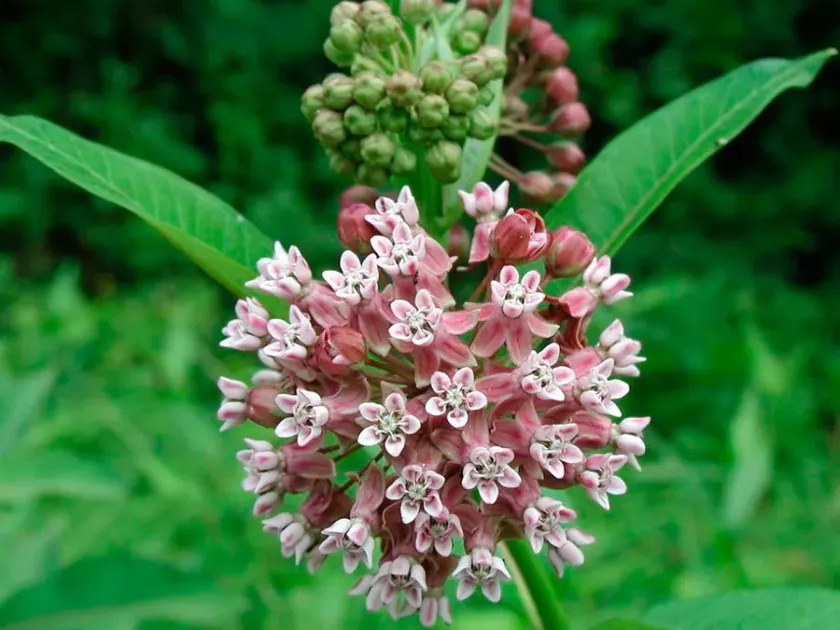
Its flowers are distinctively fragrant, arranged in large, rounded umbels, and colored in various shades of pink or purple, which makes them highly attractive to bees and butterflies.
The fruit of the plant is a large, rough, warty follicle that splits open when mature to release numerous seeds, each equipped with a tuft of silky hair for wind dispersal.
A key biological feature is the presence of milky white sap within all plant tissues, which serves as a defense mechanism and makes the plant bitter and potentially toxic to livestock.
Where it grows
Common milkweed thrives in a variety of environments, particularly in full sun, and is commonly found in disturbed soils, roadsides, pastures, and uncultivated fields.
It adapts well to sandy, loamy, and gravelly soil types, often forming dense, monocultural colonies that can quickly invade adjacent agricultural landscapes.
The weed is a significant nuisance in row crops, particularly in corn and soybean fields, where it competes aggressively with the primary crop for sunlight and nutrients.
Due to its persistent rhizomes, it is capable of surviving harsh winter conditions and re-emerging vigorously in the spring, making it a perennial threat to arable land.
Invasion often starts from fence rows or ditch banks, gradually encroaching into the field interior and causing yield losses that increase with the density of the infestation.
Harm it causes
The primary economic impact of common milkweed is the reduction of crop yields through competition for essential resources like soil moisture, nutrients, and sunlight.
The dense vegetative growth of milkweed creates substantial shade, which significantly suppresses the development and biomass production of shorter crop species.
Harvesting difficulties arise because the thick, fibrous stems and milky sap can clog or damage agricultural machinery, leading to downtime and increased maintenance costs.
The toxic properties of the plant pose a risk to grazing animals, as the consumption of fresh or dried plant material can cause adverse health effects in livestock.
Furthermore, the plant acts as a host for various insects and pathogens that can potentially migrate to commercial crops, necessitating additional chemical inputs for pest control.
How to control
Effective management of common milkweed requires a combination of mechanical and chemical strategies to overcome its resilient root system and high regenerative capacity.
Frequent and timely mechanical cultivation can help deplete the carbohydrate reserves stored in the extensive roots, eventually weakening the plants over several growing seasons.
Chemical control usually involves the application of systemic herbicides, particularly those based on glyphosate, applied at the bud to flowering stages to ensure translocation to the roots.
Cultural practices, such as intensive crop rotation and the use of competitive cover crops, are essential to minimize the establishment of new colonies in the field.
- Use of systemic herbicides during peak growth stages.
- Repeated deep cultivation to exhaust root reserves.
- Planting competitive crop varieties for better light interception.
- Monitoring field borders to prevent initial colonization.
Taxonomy
- Latin name
- Asclepias
- Family
- Кутровые
- EPPO code
- ASCSS